
Measured on 2026-10-20.
Baseline and change. The baseline is ACE-Step 1.5 XL SFT. The score's own model, the one under every film; the turbo version is set against it on the same descriptions.
The changes set against it:
- ACE-Step 1.5 XL turbo
In Optra Studio. The music test, with its listening page, in Optra Studio
These pages open for the people who work on the project. For anyone else they may show a sign-in page, or a note that the page is not theirs to open.
Both versions of a music AI made music for the same short descriptions. Nobody has judged the recordings yet, so we cannot name a winner, but you can listen to a pair of recordings for every description.
What did we want to know?
Our films need music. A person types a short description, and an AI makes the score. We asked a plain question: does the music match the description?
We tested the versions of one music AI, called ACE-Step 1.5 XL. They are named SFT and turbo. Each made music for the same descriptions, with different random seeds. The table shows the size of the test.
| Versions | Descriptions | Seeds for each | Recordings in all |
|---|---|---|---|
| 2 | 10 | 3 | 60 |
Which files did we run?
The table gives the exact files. Both versions come from one repository at one revision.
| What ran | |
|---|---|
| Source | Comfy-Org/ace_step_1.5_ComfyUI_files |
| Revision | 6707deb277e9e0907fd9c14ce6b6f1d695c6a3fc |
| SFT file | acestep_v1.5_xl_sft_bf16.safetensors |
| Turbo file | acestep_v1.5_xl_turbo_bf16.safetensors |
What would count as right?
We wrote the bar before anything ran. For every description we listed what a listener must hear and what must not be there. A recording passes only if everything on the list to listen for is there, and nothing on the list of what must not be there is.
A listener marks each recording right or wrong that way, without knowing which version made it. A program that follows the beat is also to check the tempo.
How can you judge them yourself?
Below, each description has a pair of recordings, A and B. One is the SFT version and one is the turbo version. Which is which stays sealed until the listener has marked them. The letters are shuffled for each description, so A is not the same version every time.
These are the first seed of each description. We set every recording to the same loudness, so that a louder one does not seem better. Nothing else was changed. Compare each pair against what the description asks for.
Acoustic guitar with rain
The description was: warm acoustic guitar, slow, gentle rain, no drums
Listen for an acoustic guitar that leads, a slow and calm feel, and rain underneath. There should be no drums or beat, and no singing.
Version A for the description: acoustic guitar with rain.
Version B for the description: acoustic guitar with rain.
A tense chase
The description was: tense orchestral strings for a chase, fast, 140 BPM, brass hits
Listen for strings that drive the piece, brass hits, and a fast, urgent feel. There should be no singing and no slow, gentle passage.
Version A for the description: a tense chase.
Version B for the description: a tense chase.
A sad piano goodbye
The description was: soft solo piano, sad, for a goodbye at a railway station
Listen for a piano on its own, and a sad feel. There should be no drums, no singing and no other instrument.
Version A for the description: a sad piano goodbye.
Version B for the description: a sad piano goodbye.
Indian classical music
The description was: Indian classical: sitar and tabla, morning raga feel, medium tempo
Listen for a sitar, tabla and an Indian classical feel. There should be no drum kit, no electric guitar and no singing.
Version A for the description: indian classical music.
Version B for the description: indian classical music.
A festive Arabic wedding
The description was: Arabic oud and darbuka, festive wedding mood, upbeat
Listen for an oud, a darbuka or hand drum, and a festive, upbeat feel. It should not sound sad, and there should be no electric guitar.
Version A for the description: a festive arabic wedding.
Version B for the description: a festive arabic wedding.
A horror drone
The description was: dark ambient drone, horror, low synth pads, no melody
Listen for low synth pads and a dark, uneasy mood. There should be no clear melody, no drums and no singing.
Version A for the description: a horror drone.
Version B for the description: a horror drone.
A cartoon with a ukulele
The description was: cheerful ukulele and whistling for a kids’ cartoon, bouncy, 120 BPM
Listen for a ukulele, whistling, and a cheerful, bouncy feel. It should not sound dark or sad, and there should be no singing with words.
Version A for the description: a cartoon with a ukulele.
Version B for the description: a cartoon with a ukulele.
Lo-fi hip hop for studying
The description was: lo-fi hip hop beat, mellow, vinyl crackle, 85 BPM, for a study scene
Listen for a mellow hip hop beat, vinyl crackle and a relaxed feel. There should be no rapping or singing, and no fast tempo.
Version A for the description: lo-fi hip hop for studying.
Version B for the description: lo-fi hip hop for studying.
Epic trailer music
The description was: epic cinematic trailer music, big drums, choir without words, rising
Listen for big drums, a choir without words, and a build that rises. There should be no singing with words and no quiet ending.
Version A for the description: epic trailer music.
Version B for the description: epic trailer music.
A late-night jazz trio
The description was: smooth jazz trio, brushed drums, upright bass, piano, late night bar
Listen for brushed drums, an upright bass, a piano, and a relaxed late-night feel. There should be no electric guitar, no singing and no electronic sounds.
Version A for the description: a late-night jazz trio.
Version B for the description: a late-night jazz trio.
How fast was each version?
The table shows how long one recording took and how long each whole set took. The first SFT recording took 151 seconds, because it loaded the model.
The turbo set ran on GPUs that were lent to other jobs between recordings, so this is not a fair race.
| Version | Shortest (s) | Longest (s) | Whole set (minutes) |
|---|---|---|---|
| SFT | 7 | 12 | 7.3 |
| Turbo | 2 | 60 | 45.0 |
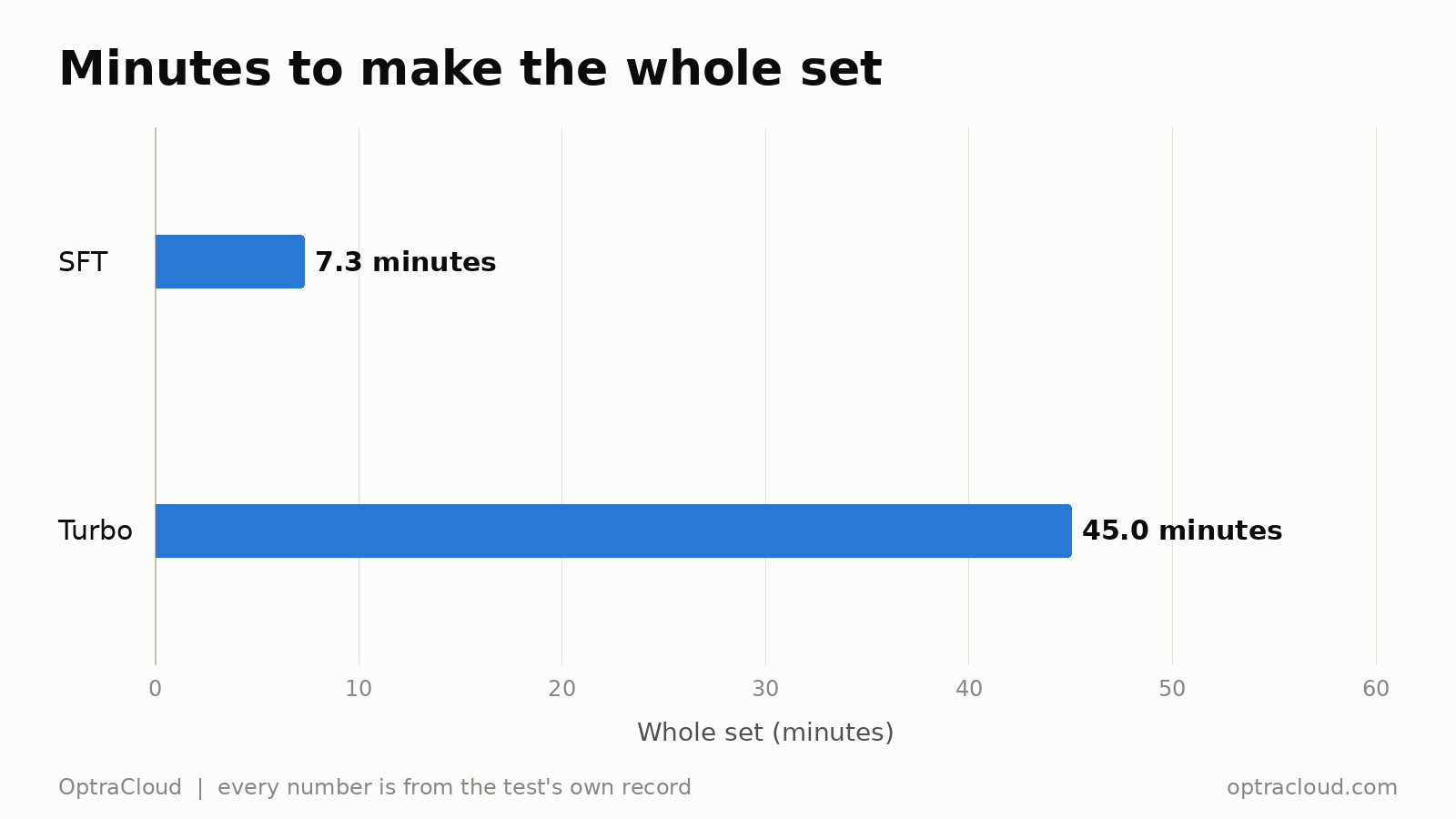
Minutes to make the whole set
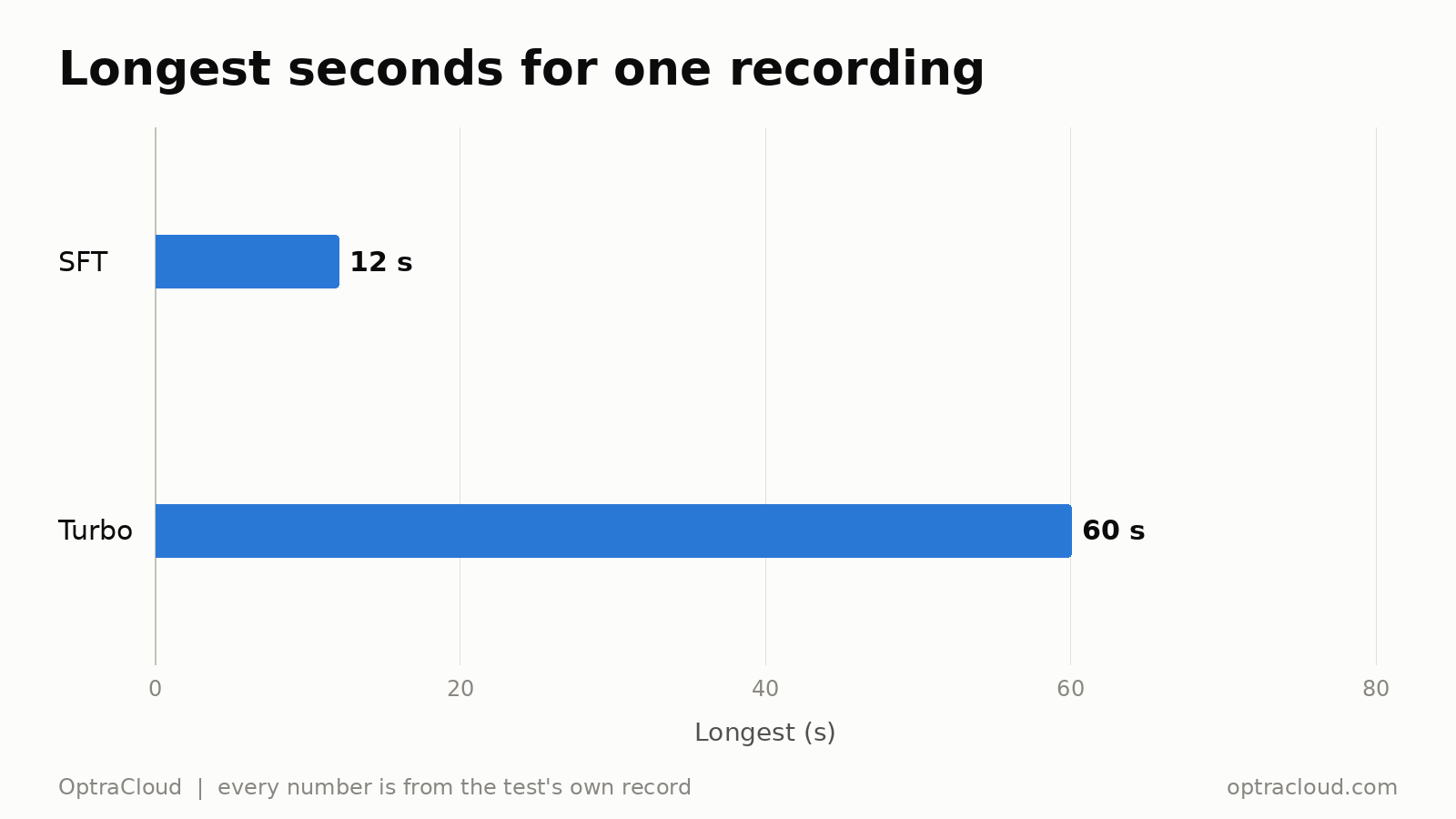
Longest seconds for one recording
To share. Pictures of these numbers, made from the same record and sized for a phone:
What did we not measure?
Nobody has marked the recordings, so neither version has been judged against the bar, and this post names no winner.
You heard only the first seed of each description. The tempo check is not shown. A very quiet recording was raised to the common loudness, which also raises its background noise.
What does this mean?
Whether the music fits the words is something an ear decides. Compare the pairs yourself. The key to the letters and the verdict come after the marks.
Quick Search Our Blogs
Type in keywords and get instant access to related blog posts.


