
Measured on 2026-10-21.
Baseline and change. The baseline is Chatterbox. The English voice we use today; the Hindi voices are set against it.
The changes set against it:
- IndicF5
- Indic Parler-TTS
- F5-Hindi
- Sooktam-2
- Veena
In Optra Studio. The test lives here:
- The Hindi voice test, with its listening page, in Optra Studio
- The same test on Optra Studio's Testing page
These pages open for the people who work on the project. For anyone else they may show a sign-in page, or a note that the page is not theirs to open.
Several AI voices read the same Hindi sentences, and nobody who speaks Hindi has judged them yet. So we can show you the real recordings, but we cannot name a winner.
What did we want to know?
We want to offer Hindi narration in our films. So we asked a plain question: which AI voice reads Hindi well enough to offer?
We ran every voice on the same lines, several times each. A native Hindi speaker is to mark every recording right or wrong, without knowing which voice made it. The table shows the size of the test.
| Voices | Hindi lines | Readings of each line | Recordings in all |
|---|---|---|---|
| 6 | 22 | 3 | 396 |
What would count as good enough?
We wrote the bar before any voice ran. A voice is offered only if at least 90% of its recordings are right on the plain lines, and at least 75% on the hard lines. No recording may be in another language.
The lines fall into groups: plain narration and dialogue; numbers, dates and money; names and English words inside a Hindi sentence; and questions, exclamations, long sentences and emotion.
Which voices did we run, and which versions?
The table gives the exact version of each voice. Chatterbox is the baseline that the others are compared with.
| Voice | Source | Version |
|---|---|---|
| Chatterbox (the baseline) | ResembleAI/chatterbox | 5bb1f6e |
| IndicF5 | ai4bharat/IndicF5 | fb652a9 |
| Indic Parler-TTS | ai4bharat/indic-parler-tts | 660bc53 |
| F5-Hindi | SPRINGLab/F5-Hindi-24KHz | 4885562 |
| Sooktam-2 | bharatgenai/sooktam2 | eb270c0 |
| Veena | maya-research/Veena | 8b770f9 |
How can you judge them yourself?
Below are real recordings of a few lines. Every voice read every line. The letters A to F are a blind, and each letter is the same voice on every line. Which voice is which stays sealed until the Hindi speaker has marked the recordings, so you hear them as that listener will.
We set every recording to the same loudness, so that a louder voice does not seem better. Nothing else was changed. These are the first of the 3 readings of each line.
Listen for words that are dropped or changed, an English-sounding accent, a robotic or rushed voice, and any switch into another language.
A plain sentence
The line is: माँ ने कहा, “खाना ठंडा हो जाएगा, जल्दी आओ।”
In English, a mother says that the food will go cold, so come quickly. It is dialogue inside a narration.
Voice A reading the first line.
Voice B reading the first line.
Voice C reading the first line.
Voice D reading the first line.
Voice E reading the first line.
Voice F reading the first line.
A sentence with a year
The line is: उसने 2014 में यह घर ख़रीदा था।
In English: he bought this house in 2014. A year can be said in several ways, so listen to how each voice says it.
Voice A reading the second line.
Voice B reading the second line.
Voice C reading the second line.
Voice D reading the second line.
Voice E reading the second line.
Voice F reading the second line.
A sentence with city names
The line is: रवि और प्रिया दिल्ली से मुंबई गए।
In English: the characters went from Delhi to Mumbai. Place names are easy to get wrong.
Voice A reading the third line.
Voice B reading the third line.
Voice C reading the third line.
Voice D reading the third line.
Voice E reading the third line.
Voice F reading the third line.
How fast was each voice?
Each number is the time to make one line, in seconds, from the studio’s own timing panel. The voices did not all run on the same kind of GPU, so read the gaps as rough.
Most voices need under half a minute a line. IndicF5 is far slower.
| Voice | Version | Seconds a line (s) |
|---|---|---|
| F5-Hindi | 4885562 | 15.7 |
| Chatterbox (the baseline) | 5bb1f6e | 16.2 |
| Indic Parler-TTS | 660bc53 | 19.4 |
| Veena | 8b770f9 | 23.9 |
| Sooktam-2 | eb270c0 | 26.1 |
| IndicF5 | fb652a9 | 206.0 |
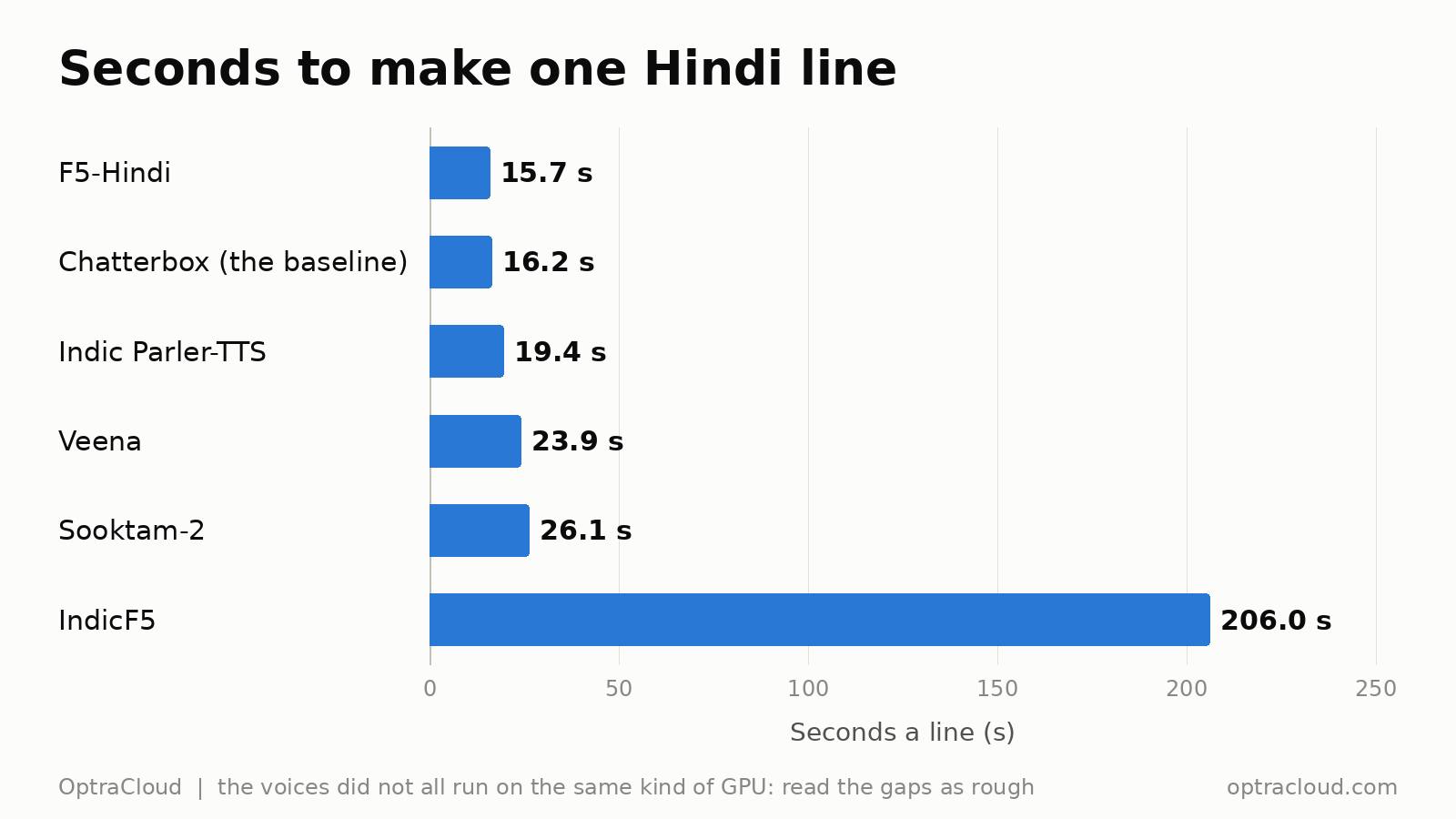
Seconds to make one Hindi line
To share. Pictures of these numbers, made from the same record and sized for a phone:
What went wrong along the way?
At first, nothing ran. For more than 3 hours after we switched the test on, no recording was made. The rule that decides when to start counted the script’s lines, not the test’s recordings. Every line of the project was already made, so nothing started. We fixed the rule.
Then a speed number was wrong. The first reading for Chatterbox said 0 seconds a line. The voice service returns a whole batch at once, so the batch’s seconds sat on the first recording and the rest read near zero. The real figure is in the table above.
Then runs failed. IndicF5 and Indic Parler-TTS each failed 4 times, because the voice service could not be reached while it was being restarted. A failing voice is now asked again after a short wait, and is never dropped from the test.
What did we not measure?
Nobody has marked the recordings. All 396 are unmarked, so no voice has been measured against the bar, and this post names no winner.
You heard only a few lines and only the first reading of each. A voice that sounds good on these may still fail on others. The English meanings are our own plain translation, given only to help you follow.
What does this mean?
Speed does not decide this test. What decides it is whether a Hindi speaker accepts the voice. The key to the letters and the verdict come after the marks.
Quick Search Our Blogs
Type in keywords and get instant access to related blog posts.


