
Measured on 2026-10-20.
Baseline and change. The baseline is Qwen3.8-27B. The model that writes our storyboards today; Gemma 4 is set against it on the same script, instructions and checks.
Each change is set against it.
In Optra Studio. The test lives here:
These pages open for the people who work on the project. For anyone else they may show a sign-in page, or a note that the page is not theirs to open.
The storyboard we thought was bad was fine. Our checks were wrong, not the AI. A second AI showed fewer of the script’s actions but, read by eye, paced the film better. It was several times slower, and our checks had to be taught its habit first.
What happened?
Our checks refused the storyboard of a film called Dinosaur Extinction. A storyboard is a list of shots, one picture and a few seconds of movement each, written from the script. The refusal said some of the script’s lines were boarded no times in a couple of scenes.
We asked a plain question. Was the AI we use, Qwen3.8-27B, writing a bad storyboard? Would a different AI, Gemma 4 31B, write a better one?
Which exact models did we run?
Both models were squeezed to a compact number format so that they fit on our GPUs. The table gives the files.
| Qwen | Gemma | |
|---|---|---|
| Model | cyankiwi/Qwen3.8-27B-AWQ-INT4 | google/gemma-4-31B-it-qat-w4a16-ct |
| Version | e3a700906e6a73ba4290b1873dc2ba8198527ab5 | 52f3f65bc7a02d555763bc923bd1d9094898219d |
| Number format | AWQ int4 | Google’s 4-bit QAT, compressed-tensors w4a16 |
How did we test them?
We gave both models the same script, with the same instructions and the same checks. Each wrote the storyboard several times.
Before any storyboard existed, we wrote down what the script does, by eye. That list has 20 actions. Then we counted how many of them each storyboard shows.
What did we find?
The table gives every storyboard. Qwen’s all passed our checks on the code of the day. The earlier refusal was a fault in the checks, which we have since fixed.
Gemma’s showed fewer of the script’s actions in this film, but our checks flagged nearly every one of its shots. The reason is below.
| Storyboard | Shots | Time (s) | Actions shown |
|---|---|---|---|
| Qwen, first board | 34 | 80 | 15 |
| Qwen, second board | 34 | 53 | 13 |
| Qwen, third board | 34 | 62 | 13 |
| Gemma, first board | 41 | 507 | 12 |
| Gemma, second board | 42 | 506 | 11 |
| Gemma, third board | 42 | 511 | 11 |
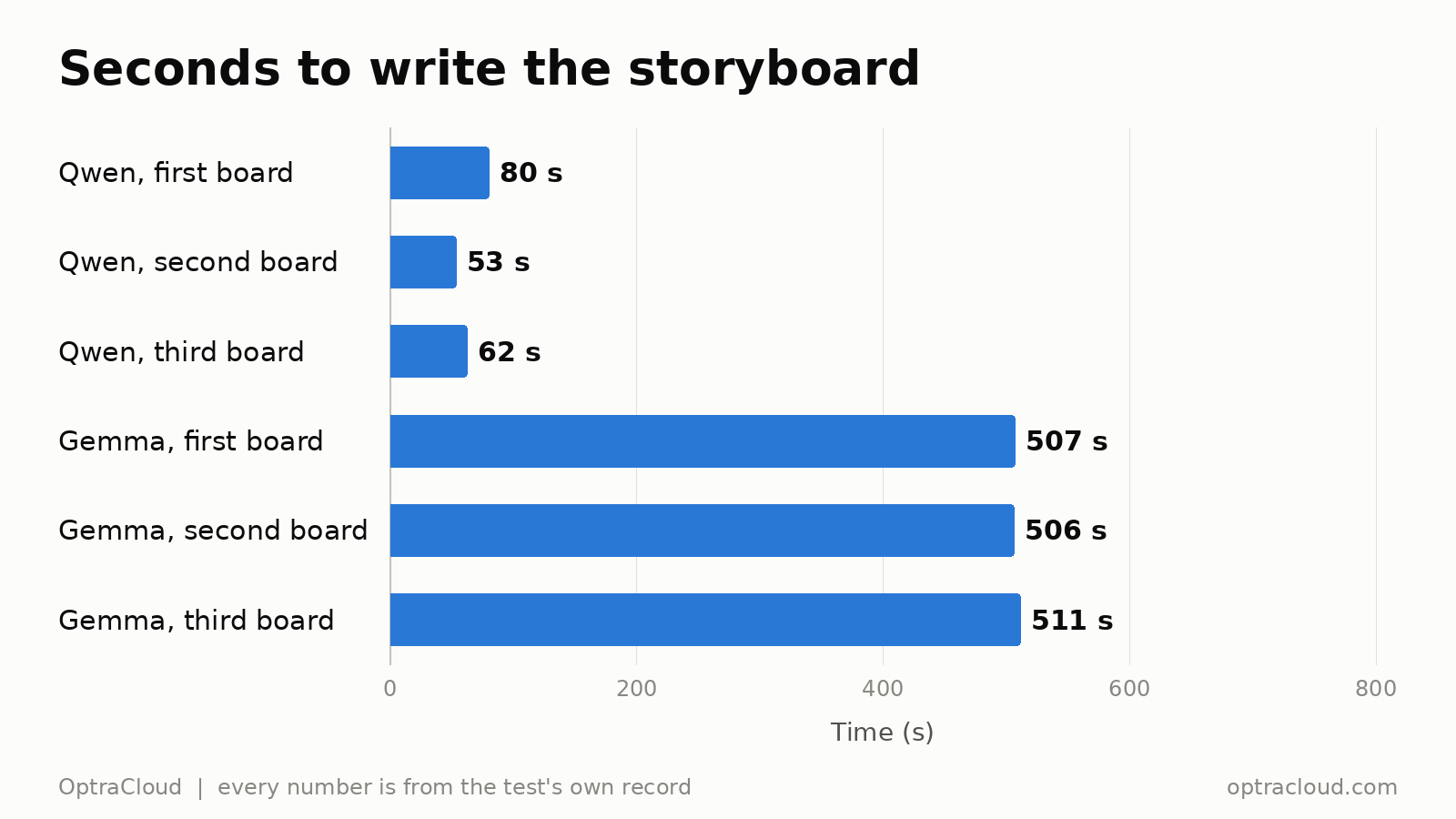
Seconds to write the storyboard
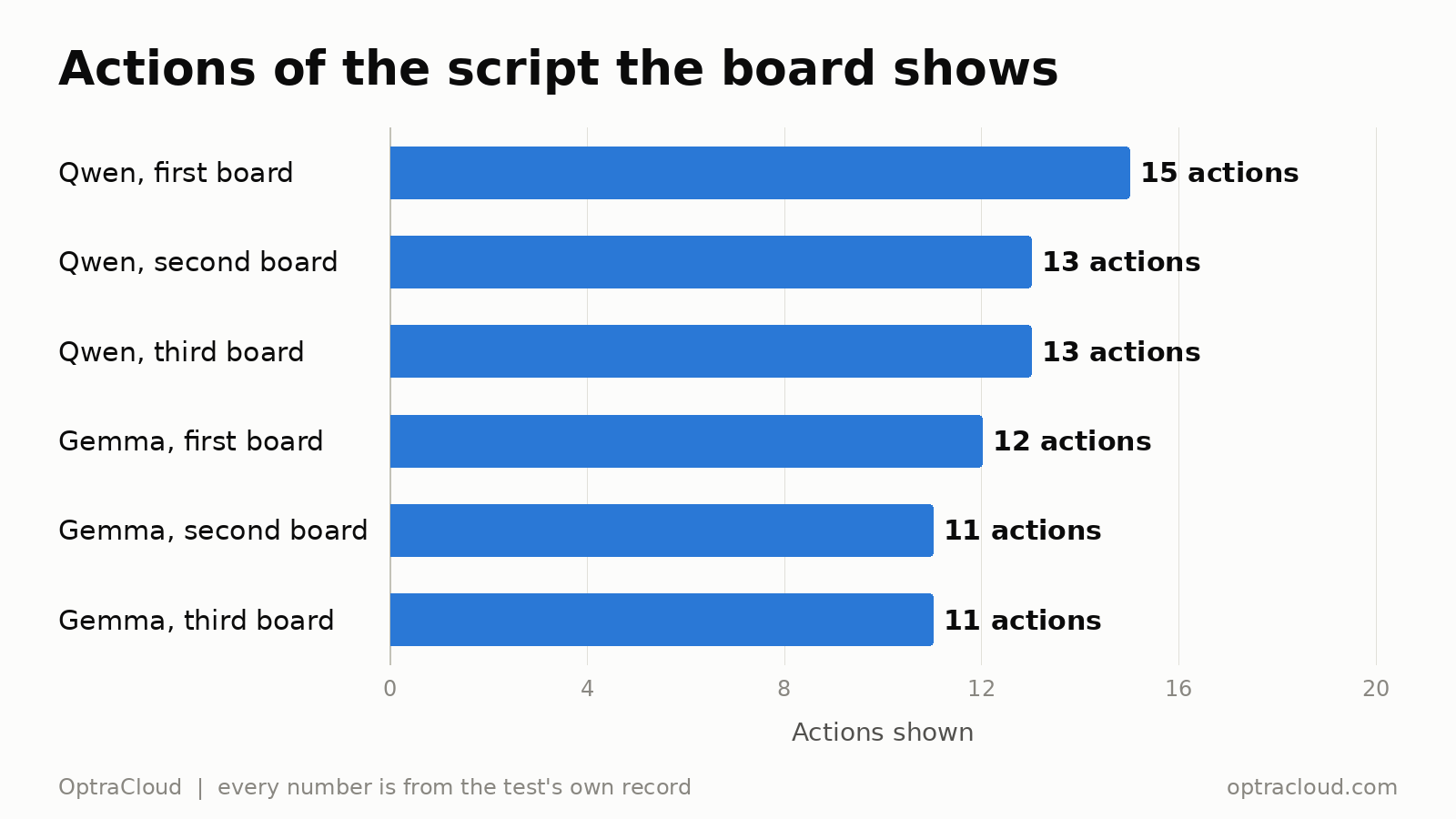
Actions of the script the board shows
To share. Pictures of these numbers, made from the same record and sized for a phone:
Why were Gemma’s shots flagged?
Gemma wrote the tag for a place or a character inside curly brackets, where our instructions ask for a plain key. So our checks flagged between 91 and 95 findings on each of its boards.
When we read the brackets as plain keys, the findings fell to between 3 and 4. Until that reading is built into our reader, Gemma would hand every shot of a project to the quality loop.
How much slower was Gemma?
Gemma took between 506 and 511 seconds for a board and its checks.
Qwen took between 53 and 62. Gemma ran several boards at once on one server, which explains part of the gap.
Can you read both storyboards?
Yes. Below is the first board each model wrote, every shot, word for word, scene by scene. Each row lines up the shots by what the narrator says. A blank means that model wrote no matching shot at that point.
Read by eye, Gemma’s board kept the script’s order and filled its beats in the middle scenes. Judge it yourself.
Scene 1: Qwen3.8-27B wrote 3 shots; Gemma 4 31B wrote 5 shots
| Qwen3.8-27B | Gemma 4 31B |
|---|---|
|
Shot: 1 (part 1.1), 8 seconds
Narration: Sixty-six million years ago, Earth was a very different world. Giant dinosaurs ruled the land.
Picture: Wide aerial shot of {prehistoric_forest} at dawn. Golden sunlight streams through the canopy, illuminating winding rivers and distant mountains. The landscape is vast and untouched, with mist rising from the valleys.
Motion: The camera slowly pans across the landscape, revealing the scale of the ancient world.
|
Shot: 1 (part 1.1), 6 seconds
Narration: Sixty-six million years ago, Earth was a very different world.
Picture: A wide aerial shot of {prehistoric_forest} at dawn, showing winding rivers and enormous mountains under golden sunlight.
Motion: The camera sweeps forward over the canopy of the forest.
|
| no matching shot |
Shot: 2 (part 1.1), 4 seconds
Narration: Giant dinosaurs ruled the land.
Picture: A medium shot of {t_rex} standing in {prehistoric_forest}, illuminated by golden sunlight filtering through leaves.
Motion: {t_rex} opens its mouth wide and expands its chest.
|
|
Shot: 2 (part 1.1), 8 seconds
Narration: From the mighty Tyrannosaurus rex to the peaceful Triceratops, life flourished across ancient forests and endless plains.
Picture: Wide shot of {prehistoric_forest} at dawn. A herd of {triceratops} walks across a lush valley. {hadrosaur} graze peacefully in the foreground. {pterosaur} fly overhead. Golden sunlight illuminates the scene.
Motion: {triceratops} walk slowly across the frame. {hadrosaur} lower their heads to graze. {pterosaur} glide silently above.
|
Shot: 3 (part 1.1), 7 seconds
Narration: From the mighty Tyrannosaurus rex to the peaceful Triceratops, life flourished across ancient forests and endless plains.
Picture: A wide shot in {prehistoric_forest} with {t_rex} seen from behind in the foreground and {triceratops} in the distance, illuminated by golden sunlight.
Motion: {triceratops} walks three steps across the lush valley.
|
|
Shot: 3 (part 1.1), 8 seconds
Narration: For millions of years, these magnificent creatures dominated our planet. But their world was about to change forever.
Picture: Low angle wide shot of {t_rex} standing in {prehistoric_forest}. Its massive head and small arms are visible against the backdrop of towering trees. Golden sunlight from the sky highlights its reddish-brown skin.
Motion: {t_rex} steps forward from the shadows, its head turning slightly as it surveys the area.
|
Shot: 4 (part 1.1), 6 seconds
Narration: For millions of years, these magnificent creatures dominated our planet.
Picture: A wide shot of {prehistoric_forest} with {hadrosaur} on the ground and {pterosaur} in the sky, illuminated by golden sunlight.
Motion: {hadrosaur} lowers its head to graze while {pterosaur} glides across the frame.
|
| no matching shot |
Shot: 5 (part 1.1), 4 seconds
Narration: But their world was about to change forever.
Picture: A close-up of the eye of {t_rex} in {prehistoric_forest}, reflecting the golden sunlight.
Motion: {t_rex} blinks slowly.
|
Scene 2: Qwen3.8-27B wrote 4 shots; Gemma 4 31B wrote 4 shots
| Qwen3.8-27B | Gemma 4 31B |
|---|---|
|
Shot: 4 (part 2.1), 4 seconds
Narration: Far beyond the peaceful forests of Earth, a deadly visitor was approaching.
Picture: Wide shot of {outer_space}. A small blue planet, Earth, sits in the lower left corner, illuminated by distant sunlight. The vast darkness of space fills the frame, dotted with distant stars.
Motion: The camera holds a static wide view of the small Earth against the starry void.
|
Shot: 6 (part 2.1), 6 seconds
Narration: Far beyond the peaceful forests of Earth, a deadly visitor was approaching.
Picture: A wide shot of {outer_space} with distant stars. A small, blue and green Earth is visible in the distance, illuminated by distant sunlight.
Motion: The camera slowly pulls away from Earth, moving deeper into the void.
|
|
Shot: 5 (part 2.1), 5 seconds
Narration: An enormous asteroid, roughly ten kilometers across, was racing toward our planet.
Picture: Medium shot of {asteroid} in {outer_space}. The object fills the frame, its irregular surface illuminated by distant sunlight from the left.
Motion: {asteroid} moves slowly forward through the darkness of space.
|
Shot: 7 (part 2.1), 7 seconds
Narration: An enormous asteroid, roughly ten kilometers across, was racing toward our planet.
Picture: A medium shot of {asteroid} in {outer_space}. The irregular rocky surface of {asteroid} is illuminated by distant sunlight against the blackness.
Motion: {asteroid} moves forward through the frame from right to left.
|
|
Shot: 6 (part 2.1), 4 seconds
Narration: It carried enough energy to change the course of life on Earth.
Picture: Close-up of {asteroid} in {outer_space}. The rough, rocky texture of the asteroid's surface fills the frame, lit by the harsh glare of distant sunlight.
Motion: {asteroid} continues its steady, silent drift through the void.
|
Shot: 8 (part 2.1), 6 seconds
Narration: It carried enough energy to change the course of life on Earth.
Picture: A wide shot in {outer_space} showing {asteroid} in the foreground, with the curve of Earth in the background, illuminated by distant sunlight.
Motion: {asteroid} travels steadily toward the planet.
|
|
Shot: 7 (part 2.1), 4 seconds
Narration: The dinosaurs had no way of knowing what was coming.
Picture: Wide shot of {outer_space}. {asteroid} is visible in the distance, moving toward the small, distant Earth. The scale of the void emphasizes the isolation of the planet.
Motion: {asteroid} travels closer to Earth, growing slightly larger in the frame.
|
Shot: 9 (part 2.1), 6 seconds
Narration: The dinosaurs had no way of knowing what was coming.
Picture: A close-up of the textured, grey surface of {asteroid} in {outer_space}, illuminated by distant sunlight, with the blue glow of Earth reflecting on its edge.
Motion: {asteroid} rotates slowly as it moves forward.
|
Scene 3: Qwen3.8-27B wrote 4 shots; Gemma 4 31B wrote 4 shots
| Qwen3.8-27B | Gemma 4 31B |
|---|---|
|
Shot: 8 (part 3.1), 4 seconds
Narration: Then, without warning, a brilliant light appeared in the sky.
Picture: Medium shot of {triceratops} standing in {prehistoric_landscape}, head lowered, grey-green skin illuminated by golden sunlight, {asteroid} visible as a small bright point high in the sky.
Motion: {triceratops} lifts its head slowly, eyes widening as it stares up at the bright point in the sky.
|
Shot: 10 (part 3.1), 6 seconds
Narration: Then, without warning, a brilliant light appeared in the sky.
Picture: Wide shot in {prehistoric_landscape}. {triceratops} stands in a field of ferns. A brilliant white light glows in the upper corner of the sky, illuminating the landscape. Daylight fills the scene.
Motion: {triceratops} raises its head toward the sky.
|
|
Shot: 9 (part 3.1), 5 seconds
Narration: The asteroid entered Earth's atmosphere at an unimaginable speed.
Picture: Close-up of {t_rex} in {prehistoric_landscape}, massive head turned upward, reddish-brown skin glowing under the intensifying light from the sky, {asteroid} streaking down as a fiery trail.
Motion: {t_rex} holds its gaze on the descending {asteroid}, its jaw slightly open, as the fiery trail grows larger and brighter in the sky.
|
Shot: 11 (part 3.1), 6 seconds
Narration: The asteroid entered Earth's atmosphere at an unimaginable speed.
Picture: Medium shot in {prehistoric_landscape}. {t_rex} is seen from the chest up, facing the camera. The sky behind is glowing white. Daylight illuminates the scene.
Motion: {t_rex} narrows its eyes and tilts its head toward the light.
|
|
Shot: 10 (part 3.1), 6 seconds
Narration: Within moments, the fate of an entire world would be transformed.
Picture: Wide shot of {prehistoric_landscape} with {asteroid} dominating the sky, a blinding white fireball expanding rapidly, illuminating the entire landscape in harsh white light, silhouettes of trees visible in the foreground.
Motion: {asteroid} expands into a massive fireball, filling the sky with blinding light and heat, casting long, sharp shadows across the landscape.
|
Shot: 12 (part 3.1), 6 seconds
Narration: Within moments, the fate of an entire world would be transformed.
Picture: Wide shot of {prehistoric_landscape}. The {asteroid} is a streak of blinding white fire cutting through the glowing sky. The ground below is bathed in intense white light from the {asteroid}.
Motion: The {asteroid} descends rapidly toward the horizon.
|
|
Shot: 11 (part 3.1), 5 seconds
Narration: The age of the dinosaurs was approaching its darkest hour.
Picture: Extreme wide shot of {prehistoric_landscape} from a high angle, the sky completely white with the light of the {asteroid}, the ground below dark and shadowed, the horizon line barely visible.
Motion: The light from the {asteroid} intensifies until the entire frame is washed out in white, the landscape disappearing into the glare.
|
Shot: 13 (part 3.1), 6 seconds
Narration: The age of the dinosaurs was approaching its darkest hour.
Picture: Low-angle medium shot in {prehistoric_landscape}. {triceratops} is seen from behind, looking up at the sky. The sky is a blinding, saturated white. Daylight is harsh.
Motion: {triceratops} lets out a breath, its chest expanding and contracting.
|
Scene 4: Qwen3.8-27B wrote 6 shots; Gemma 4 31B wrote 6 shots
| Qwen3.8-27B | Gemma 4 31B |
|---|---|
|
Shot: 12 (part 4.1), 4 seconds
Narration: The asteroid slammed into Earth with unimaginable force.
Picture: Extreme wide shot of {yucatan_region} at the moment of impact. A blinding white flash erupts from the center of the frame, illuminating the surrounding landscape. The {asteroid} is visible as a bright point of light just before it vanishes into the ground. The light is intense and white.
Motion: The blinding flash expands rapidly outward from the impact point, washing out the details of the landscape in a wave of white light.
|
Shot: 14 (part 4.1), 5 seconds
Narration: The asteroid slammed into Earth with unimaginable force.
Picture: A wide shot of {yucatan_region} as the {asteroid} strikes the ground, creating a blinding white flash that fills the center of the frame, illuminated by the impact.
Motion: The {asteroid} disappears into the ground as a white light expands rapidly outward.
|
|
Shot: 13 (part 4.1), 5 seconds
Narration: The impact released an enormous amount of energy, carving a vast crater into the planet's surface.
Picture: Wide shot of the {yucatan_region} surface. A colossal fireball expands into the atmosphere, glowing orange and red. Rock and debris are thrown high above the ground. The {crater} is visible as a dark, churning pit in the center, surrounded by ejected material. The light comes from the fireball and the glowing debris.
Motion: The fireball billows upward and outward, while chunks of rock and debris arc through the air, falling back toward the {crater}.
|
Shot: 15 (part 4.1), 6 seconds
Narration: The impact released an enormous amount of energy, carving a vast crater into the planet's surface.
Picture: An extreme wide shot of {yucatan_region} showing the {crater} forming as a colossal fireball expands upward, illuminated by the impact.
Motion: The {crater} widens as the fireball rises and pushes a ring of fire outward.
|
|
Shot: 14 (part 4.1), 4 seconds
Narration: Violent earthquakes shook the ground.
Picture: Low angle wide shot of the ground in {yucatan_region}. The earth is cracking and shifting violently. Dust and small rocks are thrown into the air by the tremors. The light is dim, filtered through the rising dust and smoke from the impact.
Motion: The ground heaves and cracks, sending plumes of dust and loose stones flying upward as the earth shakes.
|
Shot: 16 (part 4.1), 4 seconds
Narration: Violent earthquakes shook the ground.
Picture: A medium shot of the rocky ground in {yucatan_region}, illuminated by the impact, with deep fissures opening in the earth.
Motion: The ground heaves upward and cracks violently.
|
|
Shot: 15 (part 4.1), 4 seconds
Narration: Massive tsunamis surged across the oceans.
Picture: Wide shot of the ocean horizon in {yucatan_region}. A massive wall of water, a tsunami, surges across the surface. The water is dark and churning, illuminated by the fading glow of the impact and the smoke in the sky.
Motion: The massive wave of water moves rapidly across the ocean surface, towering high above the horizon line.
|
Shot: 17 (part 4.1), 5 seconds
Narration: Massive tsunamis surged across the oceans.
Picture: A wide shot of a coastline in {yucatan_region} with a wall of water reaching the sky, illuminated by the impact.
Motion: The wall of water surges forward, crashing into the shoreline.
|
|
Shot: 16 (part 4.1), 4 seconds
Narration: Debris was blasted high into the atmosphere.
Picture: High angle wide shot looking down at {yucatan_region}. Debris and rock fragments are blasted high into the atmosphere, forming a dark cloud against the sky. The light is a mix of the fading fireball glow and the ambient daylight.
Motion: The debris continues to rise and spread outward into the sky, creating a expanding cloud of dust and rock.
|
Shot: 18 (part 4.1), 5 seconds
Narration: Debris was blasted high into the atmosphere.
Picture: A low-angle wide shot of {yucatan_region} looking up at a sky filled with glowing rocks and ash, illuminated by the impact.
Motion: Chunks of rock and debris fly upward at high speed toward the top of the frame.
|
|
Shot: 17 (part 4.1), 4 seconds
Narration: In a single moment, Earth had changed forever.
Picture: Extreme wide shot of the {yucatan_region} landscape. The area is covered in a thick layer of dust and smoke. The {crater} is visible in the distance, shrouded in haze. The light is dim and grey, indicating the end of the immediate impact phase.
Motion: The dust and smoke settle slowly, obscuring the details of the landscape and the {crater} in a grey haze.
|
Shot: 19 (part 4.1), 6 seconds
Narration: In a single moment, Earth had changed forever.
Picture: An extreme wide shot from high altitude showing the {yucatan_region} and the surrounding continent engulfed in a spreading shockwave, illuminated by the impact.
Motion: The shockwave expands in a perfect circle across the landscape.
|
Scene 5: Qwen3.8-27B wrote 3 shots; Gemma 4 31B wrote 7 shots
| Qwen3.8-27B | Gemma 4 31B |
|---|---|
|
Shot: 18 (part 5.1), 4 seconds
Narration: But the impact was only the beginning. Across the planet, ecosystems faced catastrophic destruction.
Picture: Wide shot of {global_devastation}. {triceratops} stands in the foreground, facing left, with {triceratops} running past in the mid-ground. Flames rise from the trees behind them, illuminated by the fires.
Motion: {triceratops} runs three steps to the left, away from the flames.
|
Shot: 20 (part 5.1), 4 seconds
Narration: But the impact was only the beginning.
Picture: A wide shot of {global_devastation} with a wall of fire sweeping through the trees, illuminated by the orange glow of the fires.
Motion: The wall of fire moves from the left side of the frame to the right, consuming the forest.
|
|
Shot: 19 (part 5.1), 4 seconds
Narration: Fires burned across affected landscapes. Dust, soot, and tiny particles spread through the atmosphere, blocking sunlight.
Picture: Extreme wide shot of {global_devastation}. A dense wall of smoke and dust rises from the forest floor, blocking the sky. The light is dim and orange from the fires below.
Motion: The smoke rises steadily, filling the upper half of the frame.
|
Shot: 21 (part 5.1), 6 seconds
Narration: Across the planet, ecosystems faced catastrophic destruction.
Picture: A medium shot of {t_rex} in {global_devastation}, illuminated by the red light of fires.
Motion: {t_rex} runs forward through the smoke, moving from the background toward the camera.
|
|
Shot: 20 (part 5.1), 4 seconds
Narration: The skies darkened. Temperatures began to fall. The world that dinosaurs had known was disappearing.
Picture: Medium shot of {hadrosaur} in {global_devastation}. {hadrosaur} looks up at the dark, ash-filled sky. The light is faint and grey, coming from the ambient glow of the smoke.
Motion: {hadrosaur} lifts its head slowly, looking upward.
|
Shot: 22 (part 5.1), 5 seconds
Narration: Fires burned across affected landscapes.
Picture: A wide shot of {triceratops} in {global_devastation}, surrounded by burning trees illuminated by fires.
Motion: {triceratops} turns and gallops away from the fire toward the horizon.
|
| no matching shot |
Shot: 23 (part 5.1), 6 seconds
Narration: Dust, soot, and tiny particles spread through the atmosphere, blocking sunlight.
Picture: A low-angle shot of the sky in {global_devastation}, filled with thick black smoke and falling grey ash, illuminated by a dim, filtered sun.
Motion: The grey ash falls vertically and slowly through the frame.
|
| no matching shot |
Shot: 24 (part 5.1), 4 seconds
Narration: The skies darkened.
Picture: A wide shot of the horizon in {global_devastation}, where a massive wall of black clouds swallows the light from the fires.
Motion: The black clouds roll forward, covering the sky from the top of the frame downward.
|
| no matching shot |
Shot: 25 (part 5.1), 4 seconds
Narration: Temperatures began to fall.
Picture: A close-up of a single green leaf in {darkened_world}, illuminated by faint ambient light.
Motion: The leaf curls inward and turns brown as frost crystals form on its edges.
|
| no matching shot |
Shot: 26 (part 5.1), 7 seconds
Narration: The world that dinosaurs had known was disappearing.
Picture: A wide shot of {hadrosaur} seen from behind in {global_devastation}, walking into a thick grey haze of ash, illuminated by fires and smoke.
Motion: {hadrosaur} walks slowly away from the camera until it is swallowed by the haze.
|
Scene 6: Qwen3.8-27B wrote 6 shots; Gemma 4 31B wrote 6 shots
| Qwen3.8-27B | Gemma 4 31B |
|---|---|
|
Shot: 21 (part 6.1), 4 seconds
Narration: Without enough sunlight, plants struggled to survive.
Picture: Wide shot of {darkened_world}. Withered plants lie flat on the ash-covered ground. Faint ambient light filters through the thick grey sky. The landscape is cold and silent.
Motion: The camera holds a static wide view of the barren landscape.
|
Shot: 27 (part 6.1), 5 seconds
Narration: Without enough sunlight, plants struggled to survive.
Picture: A wide shot of {darkened_world} showing withered, grey plants drooping in the ash. Faint ambient light filters through a thick haze of grey smoke.
Motion: Ash falls slowly from the sky like snow across the dead vegetation.
|
|
Shot: 22 (part 6.1), 4 seconds
Narration: As vegetation disappeared, plant-eating dinosaurs lost their food.
Picture: Medium shot of {triceratops} in {darkened_world}. The dinosaur stands still, its grey-green skin dull under the faint ambient light. Its head is lowered toward the withered plants at its feet.
Motion: {triceratops} lowers its head to the ground and remains still.
|
Shot: 28 (part 6.1), 6 seconds
Narration: As vegetation disappeared, plant-eating dinosaurs lost their food.
Picture: A medium shot of {triceratops} in {darkened_world}. {triceratops} stands beside a patch of grey, dried shrubs under the faint ambient light.
Motion: {triceratops} lowers its head to sniff the dead shrubs and then lifts its head slowly.
|
|
Shot: 23 (part 6.1), 4 seconds
Narration: Predators soon faced the same fate.
Picture: Medium shot of {t_rex} in {darkened_world}. The massive predator stands motionless, its reddish-brown skin blending into the shadows. Its small arms hang at its sides.
Motion: {t_rex} stands perfectly still, its head slightly tilted.
|
Shot: 29 (part 6.1), 4 seconds
Narration: Predators soon faced the same fate.
Picture: A medium shot of {t_rex} in {darkened_world}. {t_rex} stands amidst a field of grey ash, illuminated by faint ambient light.
Motion: {t_rex} lets out a low, tired breath, its chest heaving slowly.
|
|
Shot: 24 (part 6.1), 4 seconds
Narration: Food chains collapsed, and countless species vanished.
Picture: Wide shot of {darkened_world}. The horizon is empty, with only the dark, ash-covered ground stretching out. The faint ambient light illuminates the desolate terrain.
Motion: The camera slowly pans across the empty, silent landscape.
|
Shot: 30 (part 6.1), 6 seconds
Narration: Food chains collapsed, and countless species vanished.
Picture: A wide shot of {darkened_world} showing a silent prehistoric valley filled with grey fog and ash, illuminated by faint ambient light.
Motion: The camera pans slowly across the empty, desolate valley.
|
|
Shot: 25 (part 6.1), 5 seconds
Narration: Over time, the great non-avian dinosaurs disappeared from Earth.
Picture: Extreme wide shot of {darkened_world}. The vast, dark landscape is completely empty of life. The faint ambient light casts long, soft shadows across the withered plants.
Motion: The camera holds a static view of the silent, empty world.
|
Shot: 31 (part 6.1), 7 seconds
Narration: Over time, the great non-avian dinosaurs disappeared from Earth.
Picture: A wide shot of {darkened_world} showing abandoned nesting grounds with empty shells half-buried in ash, illuminated by faint ambient light.
Motion: A gust of wind blows a layer of ash across the empty nests.
|
|
Shot: 26 (part 6.1), 4 seconds
Narration: An extraordinary chapter in the history of life had come to an end.
Picture: Close-up of the ash-covered ground in {darkened_world}. A single withered plant stem lies broken in the center of the frame. The faint ambient light highlights the texture of the ash.
Motion: The camera remains static on the broken plant stem.
|
Shot: 32 (part 6.1), 6 seconds
Narration: An extraordinary chapter in the history of life had come to an end.
Picture: A wide shot of {darkened_world} showing a horizon of dead, skeletal trees against a dark, ash-filled sky, illuminated by faint ambient light.
Motion: The camera slowly pulls back, revealing the vastness of the dead landscape.
|
Scene 7: Qwen3.8-27B wrote 4 shots; Gemma 4 31B wrote 4 shots
| Qwen3.8-27B | Gemma 4 31B |
|---|---|
|
Shot: 27 (part 7.1), 6 seconds
Narration: The catastrophe marked one of the greatest mass extinctions in Earth's history.
Picture: Wide shot of {earth_aftermath}. Vast empty landscapes stretch toward the horizon. Silent forests stand still under dark skies. Faint ambient light illuminates the barren ground.
Motion: The camera holds a static wide view of the silent, empty landscape.
|
Shot: 33 (part 7.1), 6 seconds
Narration: The catastrophe marked one of the greatest mass extinctions in Earth's history.
Picture: A wide shot of {earth_aftermath} showing a silent forest with grey, leafless trees under a dark sky, illuminated by returning sunlight filtering through thick clouds.
Motion: The camera pans slowly across the desolate landscape.
|
|
Shot: 28 (part 7.1), 5 seconds
Narration: Around seventy-five percent of all species disappeared.
Picture: Medium shot of {earth_aftermath}. Withered plants and bare trees fill the frame. The ground is covered in ash. Faint ambient light casts long shadows across the desolate terrain.
Motion: The camera slowly pans right across the withered vegetation.
|
Shot: 34 (part 7.1), 6 seconds
Narration: Around seventy-five percent of all species disappeared.
Picture: A medium shot of {earth_aftermath} focusing on a dried-up riverbed with cracked earth and skeletal remains of prehistoric plants, illuminated by returning sunlight.
Motion: The camera tilts up from the cracked ground to the horizon.
|
|
Shot: 29 (part 7.1), 5 seconds
Narration: The giant dinosaurs that had dominated the land were gone.
Picture: Wide shot of {earth_aftermath}. The vast empty landscape stretches toward the horizon. Silent forests stand still under the dark sky. The ground is barren and still.
Motion: The camera remains still, holding the wide view of the silent landscape.
|
Shot: 35 (part 7.1), 6 seconds
Narration: The giant dinosaurs that had dominated the land were gone.
Picture: A wide shot of {earth_aftermath} showing a vast, empty plain with silent forests, illuminated by returning sunlight.
Motion: The camera tracks forward slowly over the empty terrain.
|
|
Shot: 30 (part 7.1), 6 seconds
Narration: Yet the story of life on Earth was far from over.
Picture: Wide shot of {earth_aftermath}. Returning sunlight breaks through the dark skies, illuminating the vast empty landscapes. The light gradually brightens the scene.
Motion: The camera slowly tilts up as the returning sunlight brightens the sky.
|
Shot: 36 (part 7.1), 6 seconds
Narration: Yet the story of life on Earth was far from over.
Picture: A wide shot of {earth_aftermath} from a high angle, showing a single small green sprout pushing through the grey ash, illuminated by returning sunlight.
Motion: The camera zooms in slowly on the small green sprout.
|
Scene 8: Qwen3.8-27B wrote 4 shots; Gemma 4 31B wrote 5 shots
| Qwen3.8-27B | Gemma 4 31B |
|---|---|
|
Shot: 31 (part 8.1), 8 seconds
Narration: Some creatures survived the darkness. Small mammals endured, and birds, the only surviving dinosaurs, continued their remarkable journey.
Picture: Close-up of {mammal} peeking out from a hollow in a tree trunk, its large eyes wide, illuminated by golden sunlight filtering through fresh green leaves in {recovering_forest}.
Motion: {mammal} lifts its head and looks around, its ears twitching.
|
Shot: 37 (part 8.1), 5 seconds
Narration: Some creatures survived the darkness.
Picture: A wide shot of {recovering_forest} at dawn, with golden sunlight filtering through fresh green ferns and young trees.
Motion: The camera pans slowly across the lush greenery.
|
| no matching shot |
Shot: 38 (part 8.1), 6 seconds
Narration: Small mammals endured, and birds, the only surviving dinosaurs, continued their remarkable journey.
Picture: A medium shot of {mammal} in {recovering_forest}, peeking out from under a large green leaf, illuminated by golden sunlight.
Motion: {mammal} twitches its nose and steps forward onto the soil.
|
|
Shot: 32 (part 8.1), 4 seconds
Narration: Over millions of years, ecosystems recovered and new forms of life evolved.
Picture: Medium shot of {bird} perched on a branch in {recovering_forest}, its green and yellow plumage bright against the golden sunlight filtering through the canopy, with fresh green plants in the background.
Motion: {bird} flaps its wings once and takes flight, soaring upward.
|
Shot: 39 (part 8.1), 6 seconds
Narration: Over millions of years, ecosystems recovered and new forms of life evolved.
Picture: A medium shot of {bird} perched on a thin branch in {recovering_forest}, golden sunlight hitting its plumage.
Motion: {bird} chirps and spreads its wings.
|
|
Shot: 33 (part 8.1), 4 seconds
Narration: The asteroid ended the age of the giant dinosaurs, but it opened the door to a different world.
Picture: Wide shot of the {recovering_forest} with fresh green plants spreading across the landscape, illuminated by the rising sun.
Motion: The camera slowly pans across the vibrant, recovering vegetation.
|
Shot: 40 (part 8.1), 7 seconds
Narration: The asteroid ended the age of the giant dinosaurs, but it opened the door to a different world.
Picture: A wide shot of {recovering_forest} with {bird} flying high across the frame toward a bright horizon, illuminated by golden sunlight.
Motion: {bird} flies from the left side of the frame to the right.
|
|
Shot: 34 (part 8.1), 3 seconds
Narration: Life did not end. It began a new chapter.
Picture: Extreme wide shot of the {recovering_forest} at dawn, with the sun fully risen, casting long golden rays over the lush, green landscape.
Motion: The camera rises above the forest toward the beautiful sunrise.
|
Shot: 41 (part 8.1), 5 seconds
Narration: Life did not end. It began a new chapter.
Picture: A low-angle wide shot of {recovering_forest}, looking up at the canopy and the bright dawn sky, illuminated by golden sunlight.
Motion: The camera tilts upward toward the sun.
|
Download both storyboards, in full, as a text file
What did we not measure?
This was one film and a few runs of each model. Gemma stays on test. We have not run the other films of the bake-off on it, in a clean window.
What does this mean?
The storyboard we blamed was not bad. Our checks were. When a result looks wrong, test the checker before you blame the model, and teach your reader a new model’s habits before you compare it.
Quick Search Our Blogs
Type in keywords and get instant access to related blog posts.


