
Live since 28 Oct 2026.
You can now make a second version of your film in another language, Hindi among them, with one press on the page. Your first film stays exactly as it is.
What does it do?
On a film that already has a cut, the Film section has a box called “Make a translated version of this film”. You pick a language and press “Make it in this language”.
Then the studio does the rest. In the page’s own words: the studio translates the lines, then voices, subtitles and cuts a second film in the new language, beside this one. This film stays as it is; the pictures are not drawn again.
Why is it useful?
A film you made once can reach people who speak another language, such as Hindi. The pictures are not drawn again, so you keep the look of the film you already approved.
You also keep the first film. The new one sits beside it.
How do you use it?
First, open your film’s project and find the Film section.
Next, open the box called “Make a translated version of this film”.
Then pick a language from the list called “Language”.
Last, press “Make it in this language”. The page then shows where your request is.
What does it look like?
This is the box on one of our own test films, opened. It shows the words above, the list of languages and the button. A closed list shows only its first language.
Hindi is in the list. We have not yet kept a Hindi film to show. So here is one of our own films that exists in Arabic and in English, so you can see what a film in more than one language holds.
It holds the same pictures with a different voice and different subtitles. We cannot say here which route made this pair. It shows the result, not how the box made it.
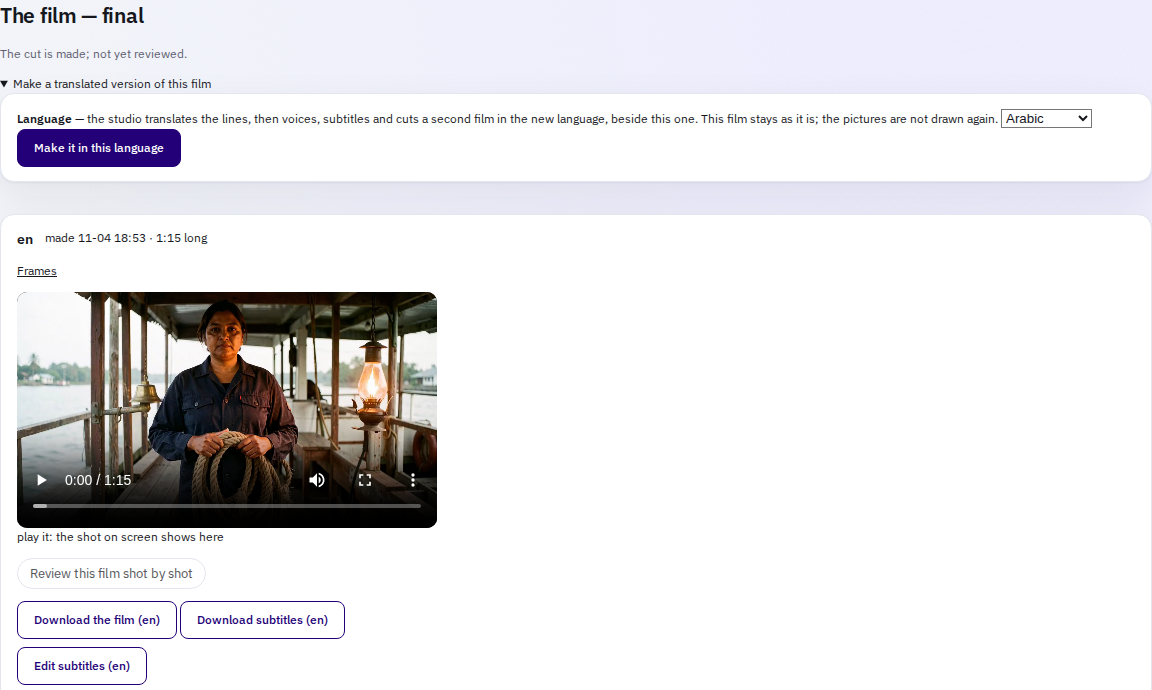
The box “Make a translated version of this film”, open, on one of our own test films.
One shot of our film Stories of Wulfa, episode one, in English, with its voice.
The same shot, in Arabic, with its voice.
The first subtitle lines of the film, in English and in Arabic (8 rows)
| Cue | English | Arabic |
|---|---|---|
| 1 | In our courtyard, every story begins with a night. Tonight is Hag Al Laila, when | في حوشنا، كل سالفة تبدا بليلة. والليلة حق الليلة، يوم |
| 2 | the children knock on every gate and sing for sweets. And my granddaughter Noora is | يطق اليهال الأبواب ويغنون ويجمعون الحلاوة. وحفيدتي نورة |
| 3 | behind the majlis wall, practising the song where she thinks nobody can hear her. | ورا طوفة المجلس، تتمرّن على الأغنية وتحسب محّد يسمعها. |
| 4 | Give to us, and God will give to you… | عطونا الله يعطيكم… |
| 5 | She stops. | توقف. |
| 6 | Give to us, and God… give to us, and God will give to you, house of… | عطونا الله… عطونا الله يعطيكم، بيت… |
| 7 | Noora! Come on, everyone's already out! | نورة! يالله، الكل طلع! |
| 8 | Coming! I'm coming! | يايه! أنا جاية! |
How well does it translate?
We checked our translation into Hindi on 20 reference lines.
In our last checks, 14 and 15 of those lines came out good.
A few were weak, 5 and 4. 1 was wrong, both times.
The wrong line is a call to prayer, the adhan, which the translator turns into a telephone call.
We marked the lines ourselves. A native speaker has not read them. So ask a Hindi speaker to read a film before you share it.
How fast is it?
We have not measured how long a translation lasts, so we give no figure here. We will add one when we have measured it.
What are the limits?
Only languages that a voice can speak are offered. A language your film already has is not offered again.
A film may have at most three more languages than its own. An episode of a series follows the languages of its series.
When the studio cannot add a language, the page says: “The studio could not add that language”. It then says why.
Quick Search Our Blogs
Type in keywords and get instant access to related blog posts.