
Measured on 2026-11-07.
Baseline and change. The baseline is Qwen-Image 2.1, the standard model. The Turbo is its faster version; the standard model drew a test film of its own on whichever graphics cards held its files.
The changes set against it:
- Qwen-Image 2.1 Turbo, the faster version
In Optra Studio. The test lives here:
These pages open for the people who work on the project. For anyone else they may show a sign-in page, or a note that the page is not theirs to open.
In a first reading, the Turbo version of Qwen-Image 2.1 drew a still in a fraction of the time of the standard model. It is not a matched test, and nobody has compared the pictures yet, so this is about seconds, not quality.
What did we want to know?
Qwen-Image 2.1 is a picture maker. Its Turbo version is a faster one. We asked a plain question. How many seconds does a still take on each? We measured on our RTX 5090 graphics cards and on the RTX 5060 Ti with 16 GB, the card the Turbo was aimed at.
What is the baseline?
The baseline is the standard Qwen-Image 2.1, the 25-step model. The Turbo is its faster version, and it is set against the standard model.
Each drew the stills of a short film of its own, at 1,920 by 1,088 pixels, with character sheets as references, on the same farm on the same day.
What did we find?
On an RTX 5090, the standard model took 19.6 seconds a still, and the Turbo took 8.2.
On the RTX 5060 Ti, the standard model took 68.4 seconds a still, and the Turbo took 27.7.
In a first reading the Turbo was about 2.4 to 2.5 times quicker. That divides one average by another, from different films, so it is not a measured speed-up.
| Model and card | Seconds a still (s) | Jobs |
|---|---|---|
| Standard, RTX 5090 | 19.6 | 4 |
| Turbo, RTX 5090 | 8.2 | 42 |
| Standard, RTX 5060 Ti | 68.4 | 2 |
| Turbo, RTX 5060 Ti | 27.7 | 12 |
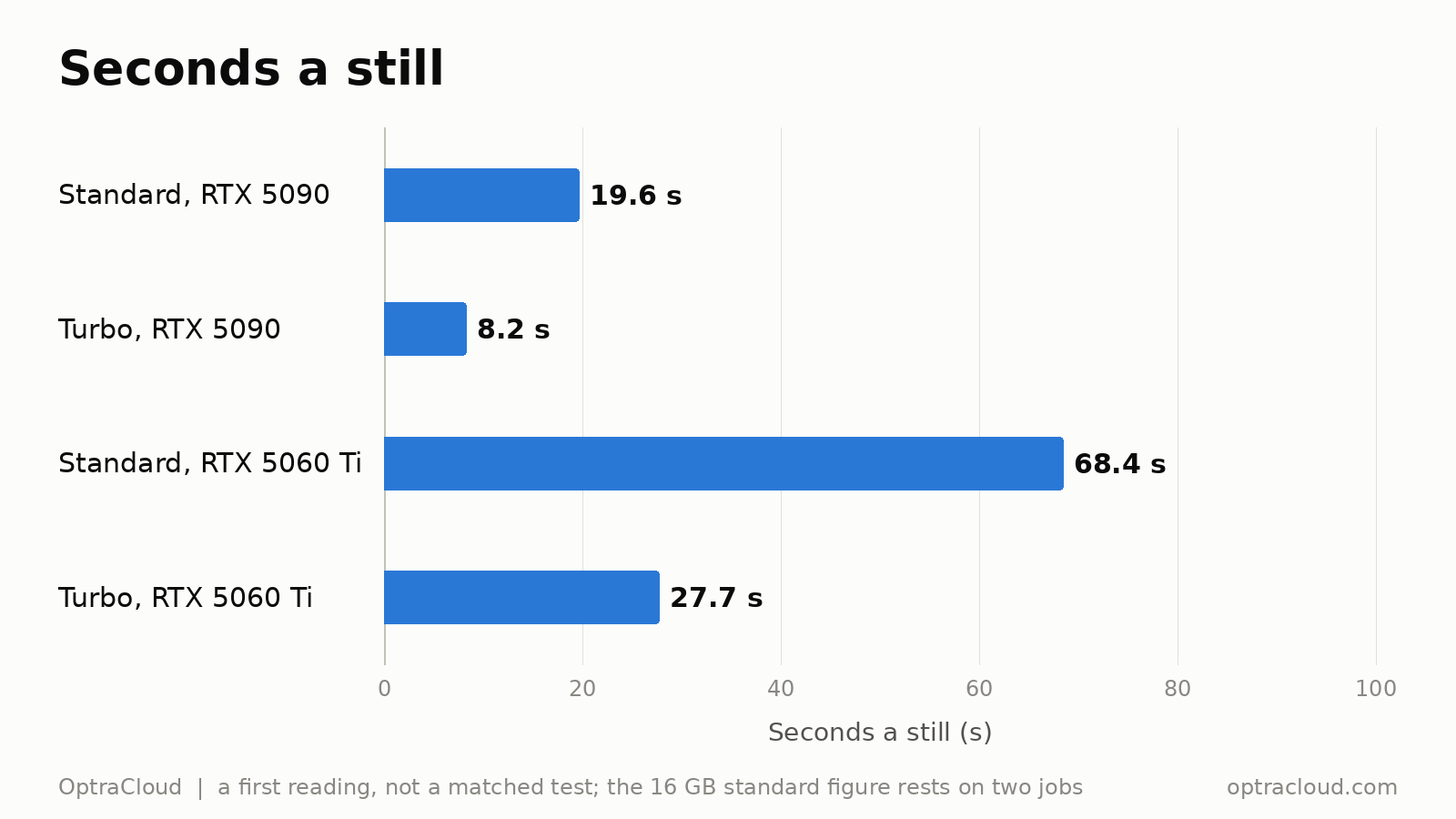
Seconds a still
To share. Pictures of these numbers, made from the same record and sized for a phone:
Why is it only a first reading?
This is not a matched test. The films have different scripts and different numbers of stills, 42 for the standard model and 54 for the Turbo, so the pictures are not the same ones.
The standard model ran on many cards and the Turbo on only a couple. The first still on a card also includes loading the model.
The standard model’s figure on the 16 GB card rests on 2 jobs, and the first of them included a model load. It is not a typical time.
What did we not measure?
We did not look at the Turbo’s pictures beside the standard model’s, so we do not say the Turbo draws as well. We also give no memory figure for either model on the 16 GB card, because the farm keeps only the highest for a card, not for each job.
What does this mean?
In a first reading the Turbo is much quicker on both kinds of card. Whether its pictures are as good is a different question, and a blind comparison will answer it.
Quick Search Our Blogs
Type in keywords and get instant access to related blog posts.