
Measured on 2026-11-07.
Baseline and change. The baseline is the original clip of each shot. It is the clip as the film maker drew it, before any upscale. FlashVSR is set against it, with SeedVR2's 3B and 7B beside it.
The changes set against it:
- FlashVSR, tiny-long mode
- FlashVSR, tiny mode
- SeedVR2 3B, from its own test
- SeedVR2 7B, from its own test
In Optra Studio. The test film's project, whose own clips are the originals, in Optra Studio
These pages open for the people who work on the project. For anyone else they may show a sign-in page, or a note that the page is not theirs to open.
In a first reading, FlashVSR doubled the size of our clips several times faster than SeedVR2, and with less memory. It also drew detail the original did not have. Nothing here says it is a better or a worse picture.
What did we want to know?
Our clips are drawn at a size that a larger screen shows soft. A video restorer can double their size. We already tested one, SeedVR2, and it was slow.
So we asked a plain question. How fast and how heavy is our own FlashVSR upscaler, what does it do to the picture, and how does it stand against SeedVR2 on the same clips?
What is the baseline?
The baseline is the original clip of each shot, as the film maker drew it. FlashVSR is set against it, and SeedVR2’s 3B and 7B stand beside it, from their own test.
How did we test it?
We took the same clips of our own test film as the SeedVR2 test. Each is 8 seconds, or 192 frames.
We doubled each to 2,688 by 1,536 pixels on one RTX 5090, in each of FlashVSR’s modes, called tiny-long and tiny.
We give only first, cold runs. Our first plan was to run each mode twice. But the second run sent the same request again, and the drawing software answered it from its memory of the first, in a fraction of a second.
That was a fault in our own measure, not in FlashVSR. We found it and fixed it: each run now asks for its own seed, and a run that ends in under a second is flagged as served from memory. So every number here is a first, cold run, and there are no warm numbers.
How fast and how heavy was it?
FlashVSR took between 125.6 and 130.8 seconds for a clip of 8 seconds.
SeedVR2’s 7B took between 540 and 550 seconds for the same clip.
Its 3B took between 708 and 720 seconds.
So in a first reading FlashVSR was about 4.3 times quicker than the 7B and 5.6 times quicker than the 3B. SeedVR2’s 3B ran first on a card that had not loaded it, so that is not a like-for-like speed.
FlashVSR’s peak memory was between 5.9 and 7.0 gigabytes.
| Shot and mode | Seconds (s) | Peak memory (MB) |
|---|---|---|
| The wide shot, tiny-long | 130.8 | 5,871 |
| The wide shot, tiny | 126.7 | 6,791 |
| The clear-face shot, tiny-long | 126.3 | 5,916 |
| The clear-face shot, tiny | 126.1 | 6,898 |
| The fine-texture shot, tiny-long | 125.6 | 5,876 |
| The fine-texture shot, tiny | 126.9 | 7,030 |
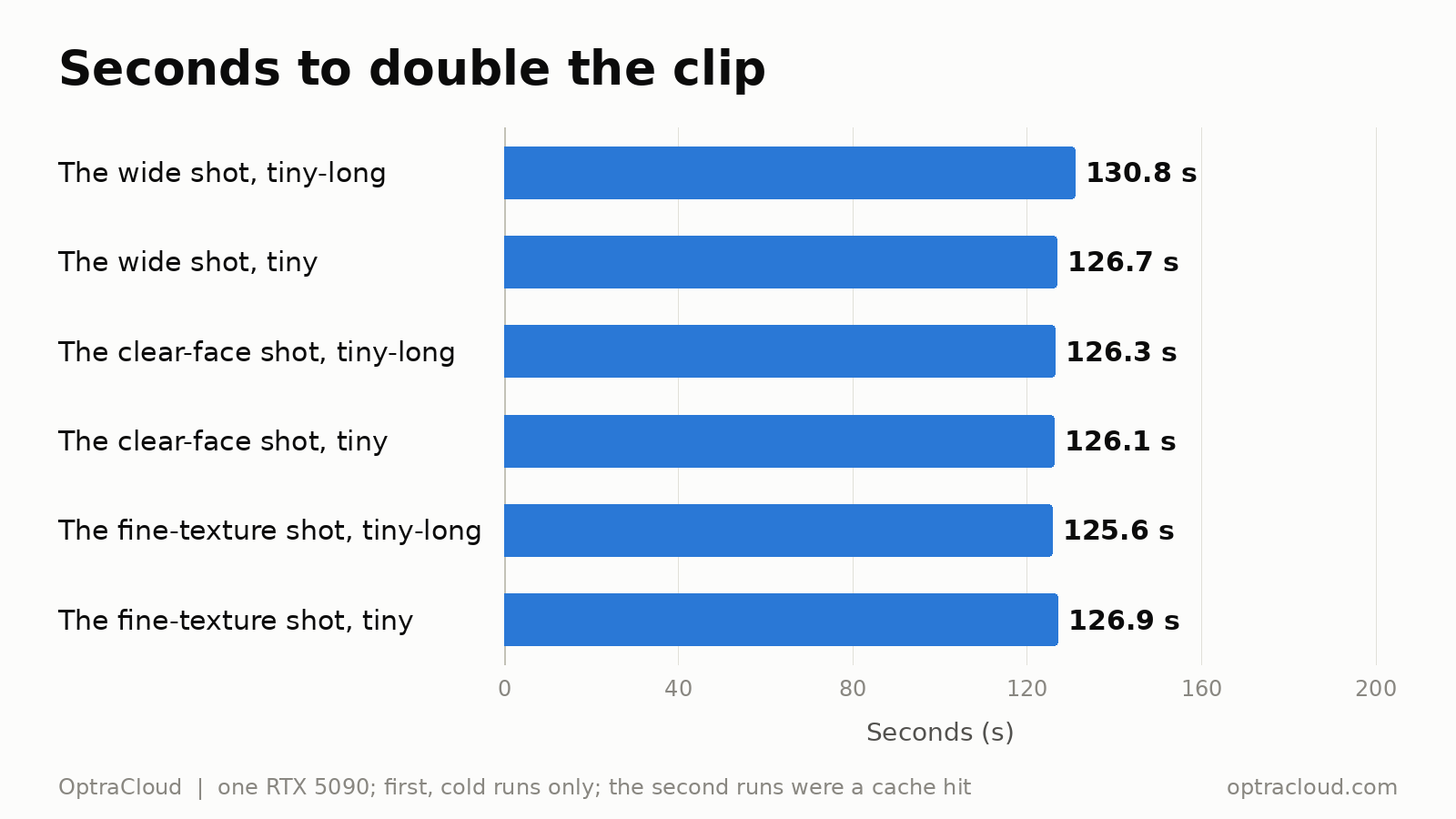
Seconds to double the clip
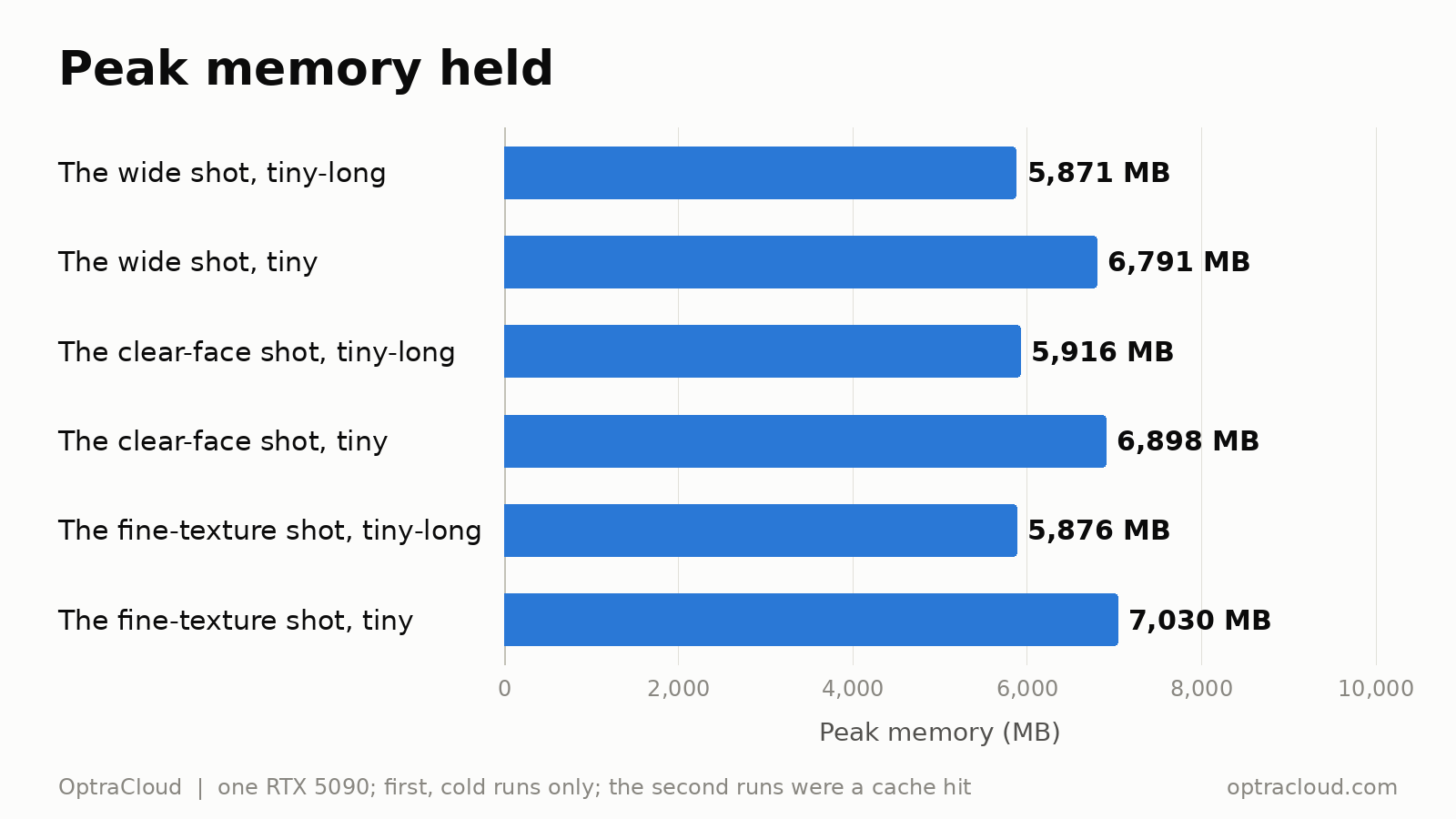
Peak memory held
To share. Pictures of these numbers, made from the same record and sized for a phone:
Do the modes differ?
No. Tiny-long and tiny gave the same picture. Tiny-long is a memory switch: its peak was 5.9 gigabytes against 6.8 to 7.0 for tiny. It is not a switch for speed or quality.
How close is it to the original?
We scaled every frame of each result back down and scored it against its original. A higher score means closer. The table gives the score for each shot, in decibels.
FlashVSR scored below SeedVR2’s 3B on every shot. Closeness is not quality. FlashVSR draws more fine texture, which lowers closeness without saying the picture is worse.
| Shot | FlashVSR | SeedVR2 3B | SeedVR2 7B |
|---|---|---|---|
| The wide shot | 28.966 | 30.77 | 33.49 |
| The clear-face shot | 30.05 | 32.66 | 34.92 |
| The fine-texture shot | 29.922 | 32.25 | 34.93 |
What did we see by eye?
One reader looked at one frame of the wide shot and 6 frames in a row of the clear-face shot. This is a spot check, not a panel.
The dock person’s face is a smear in the original and stays soft in SeedVR2. FlashVSR draws it with defined eyes, brow and lips, the clearest of the set, and sharper cap, collar and buttons. It also changes things the original had, such as the colour of the cap badge.
So FlashVSR makes the face clearer by drawing detail that was not there. The detail is invented, not recovered, and whether it is the face the story wants is a decision.
On the walking face, FlashVSR keeps the original’s head motion, with sharper hair and beard texture. It does not show the shiny cheek highlight of SeedVR2’s 3B or the lighter patch on the jaw of the 7B. A still cannot show flicker.
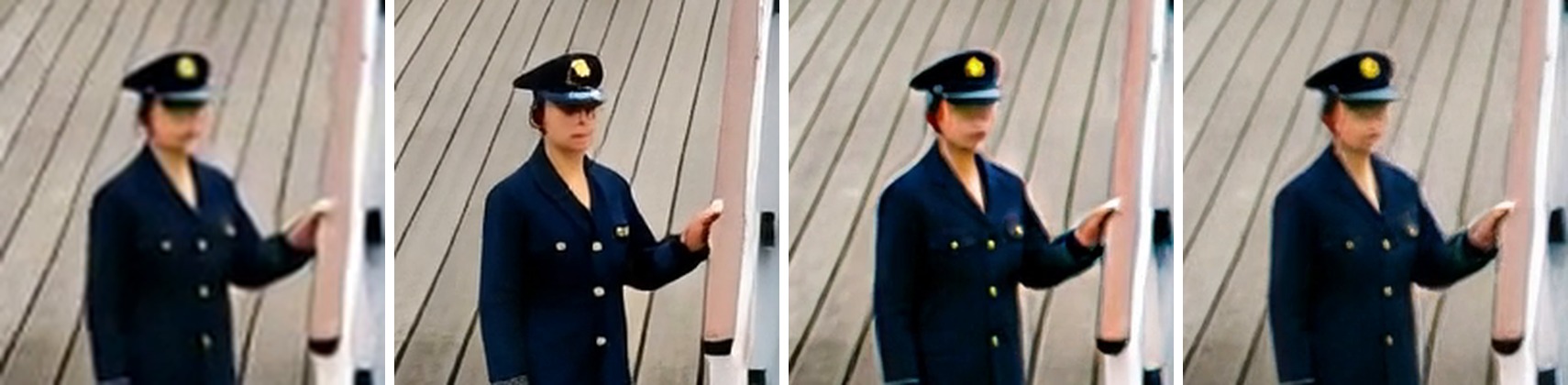
The person on the dock in one frame, from left to right: the original, FlashVSR, SeedVR2’s 3B and its 7B.
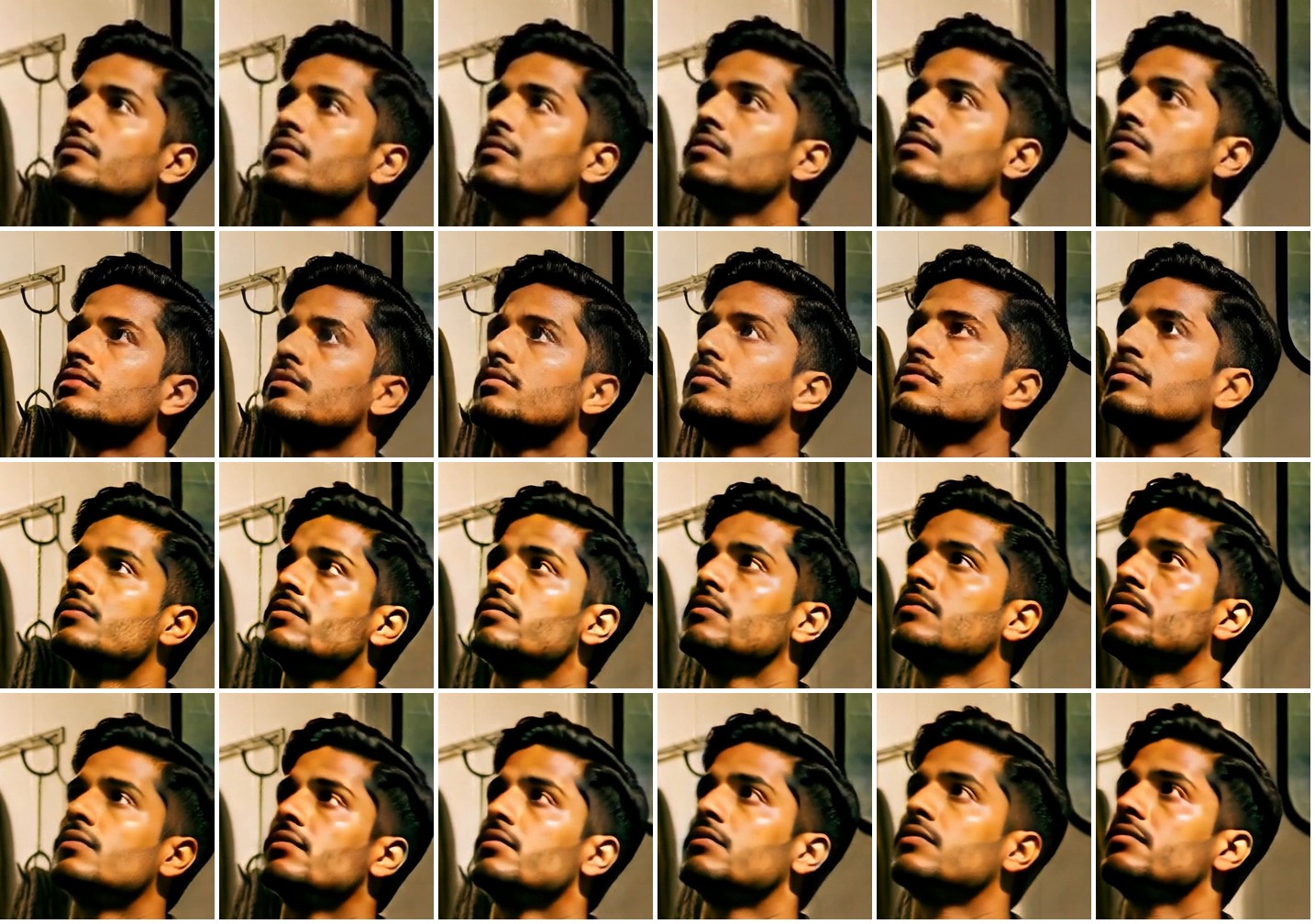
The walking face in 6 frames in a row, from top to bottom: the original, FlashVSR, SeedVR2’s 3B and its 7B.
Watch the clips
Here are the clips, shot by shot, with the original first. The original is the baseline. Next come FlashVSR in its modes and then SeedVR2’s 3B and 7B.
Each player shows a web copy that plays on a phone. For FlashVSR’s tiny-long mode a link under the player gives the full-size file as the farm made it.
The wide shot
Baseline: the original clip of each shot
Change: FlashVSR, tiny-long mode
Full-size file (42.0 MB)
Change: FlashVSR, tiny mode
Change: SeedVR2 3B, from its own test
Change: SeedVR2 7B, from its own test
The dock person’s face is a smear in the original and stays soft in both SeedVR2 results. FlashVSR draws it with defined eyes, brow and lips, but it also changes things the original had, such as the colour of the cap badge. That detail is invented, not recovered.
The clear-face shot
Baseline: the original clip of each shot
Change: FlashVSR, tiny-long mode
Full-size file (30.2 MB)
Change: FlashVSR, tiny mode
Change: SeedVR2 3B, from its own test
Change: SeedVR2 7B, from its own test
The walking face keeps the original’s head motion in FlashVSR, with sharper hair and beard texture. It does not show the shiny cheek highlight of the SeedVR2 3B or the lighter patch on the jaw of the 7B. A still cannot show flicker.
The fine-texture shot
Baseline: the original clip of each shot
Change: FlashVSR, tiny-long mode
Full-size file (39.8 MB)
Change: FlashVSR, tiny mode
Change: SeedVR2 3B, from its own test
Change: SeedVR2 7B, from its own test
Look at the fine texture in the original and in each result. Nobody has judged which looks better.
What did we not measure?
This is one card, one seed and a small set of clips. We measured speed, memory and closeness, and we made a spot check by eye. We do not say that FlashVSR is a better or a worse picture than SeedVR2.
FlashVSR also carries a rhythm in how much the picture changes from frame to frame, a smaller one than SeedVR2’s. We do not know that this is what a person sees as shaking.
What does this mean?
FlashVSR is several times quicker than SeedVR2 and needs less memory. It also draws detail that was not in the original, and for a face that is a choice, not a fix. Whether people prefer its pictures is for a blind look to say.
Quick Search Our Blogs
Type in keywords and get instant access to related blog posts.