
Measured on 2026-08-31.
Baseline. This test has no baseline: the Spark rows are computed from published numbers, not run; the comparison rows are the same model's rows in the speed table.
In Optra Studio. This test has no page in Optra Studio: its rows are worked out from published numbers, so nothing was run and there is no project page.
No outputs to show. This is a desk study of published specifications and NVIDIA’s own published benchmarks. We did not run a Spark, so we have no outputs of ours to show. The only measured row is our own pair of A5000 GPUs.
Writing words is limited by memory speed, not by raw computing power. By that arithmetic, a pair of Spark computers tops out far below our own pair of workstation GPUs.
What did we want to know?
A small computer called the DGX Spark has 128 GB of memory shared between its processor and its graphics chip. We wanted to know how fast a pair of them could write words with our 27-billion-parameter AI model. We worked it out from published numbers.
What is the speed limit of writing?
To write each word, the machine reads the whole model from memory once. So the speed limit is the memory bandwidth divided by the bytes read for each word.
For our model that is 22 GB for each word on one machine, or half that on each of a pair of machines that share the work.
How does our own measurement set the multiplier?
A real server never reaches the limit. We measured our pair of A5000 GPUs and set the result beside its limit. The table gives both.
That is an efficiency of 63 to 79 percent. We used that band for every machine, because it is our measurement and not a guess.
| Our pair of A5000 GPUs | Words a second |
|---|---|
| The speed limit | 69.8 |
| Measured, lowest | 44.3 |
| Measured, highest | 55.2 |
What does that give for the Spark?
The Spark’s memory reads at 273 GB a second per machine. Our A5000 pair reads at 768. The table gives the speed limit and the speed we would expect.
| Machine | Limit (words/s) | Low (words/s) | High (words/s) |
|---|---|---|---|
| One Spark | 12.4 | 7.8 | 9.8 |
| A pair of Sparks | 24.8 | 15.6 | 19.6 |
| A pair of A5000s, measured | 69.8 | 44.3 | 55.2 |
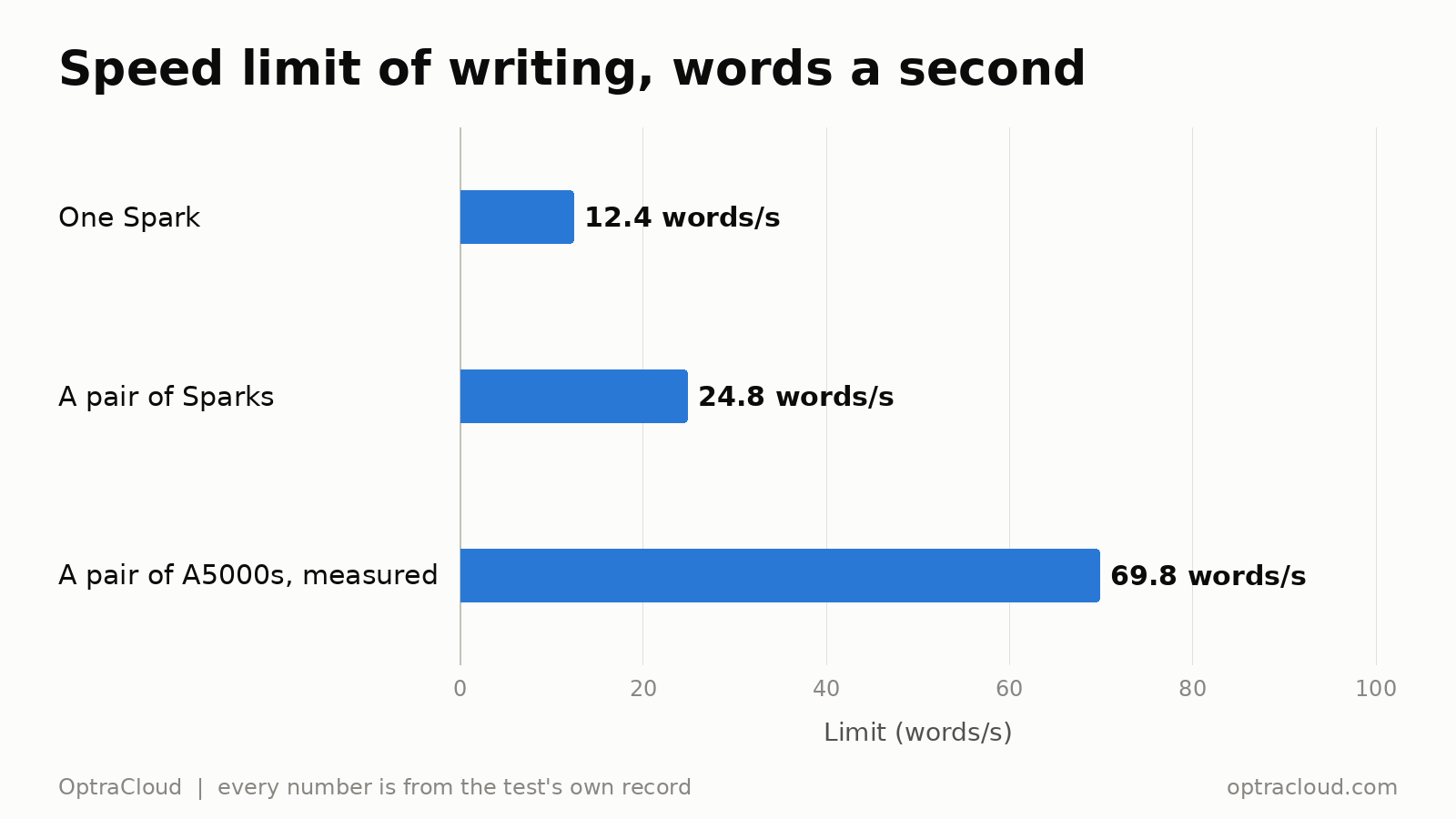
Speed limit of writing, words a second
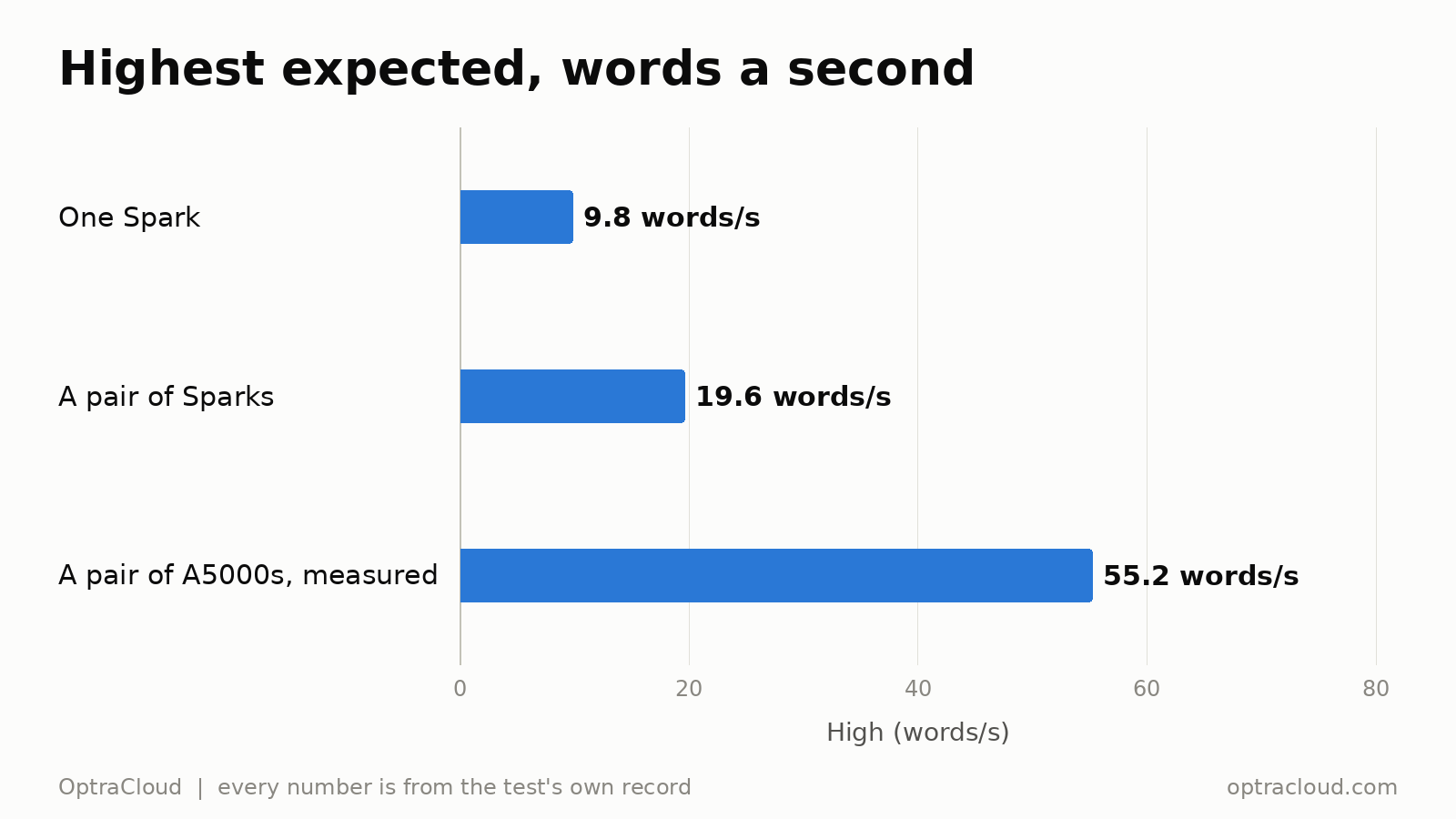
Highest expected, words a second
To share. Pictures of these numbers, made from the same record and sized for a phone:
What happens with many users?
A healthy server reads the model once and uses it for several users at the same time. NVIDIA’s own table for a large model on one Spark shows that this hardly helps.
The total rose only a little as users were added, and each user’s own speed fell fast. That is just 1.4 times as much for 4 times the users.
| Users at once | Total words a second | Words a second for each user |
|---|---|---|
| 1 | 38 | 38 |
| 2 | 47 | 23.5 |
| 4 | 53 | 13.2 |
What is fair to say in the Spark’s favour?
Its raw computing power is close to ours, so the slowdown is in writing words, not in raw computing. Splitting the work across machines also works as it should for writing words.
Reading a long prompt is still slow. NVIDIA’s own figure for a big model with a long prompt was 33.4 seconds on one machine and 21.4 on a pair.
What did we not measure?
We ran no Spark. The Spark rows are arithmetic on published numbers, with our own measured efficiency applied. We left out prices and any advice about buying.
What does this mean?
Before you judge a machine for an AI model, divide its memory speed by the size of the model. That gives a ceiling in seconds, and no amount of computing power moves it.
Quick Search Our Blogs
Type in keywords and get instant access to related blog posts.