
Measured on 2026-10-20.
Baseline and change. The baseline is Today's look. The look the studio gives a film when the brief names none; the other looks are set against it.
Each change is set against it.
In Optra Studio. This test has no page in Optra Studio: it read copies of one scene's board with blind sheets, and is not the test of a project.
Changing the look sentence moved the pictures a real distance, but only about twice as far as simply redrawing the same sentence. The warm palette did not make our films different. It made them more alike.
What did we want to know?
Our films seemed to share one warm, orange look. We wanted to know whether the sentence that describes a film’s look really changes its pictures. We also wanted to know how far, compared with the ordinary difference between a pair of redraws of the same sentence.
How did we test it?
We took one scene of a film, with 8 shots. We made copies of it, each with a different look sentence. Most copies shared the same list of shots, so a shot is the same shot in each of them.
Then we measured every picture by code. We measured how much of its colour is warm, how much is cool, and how bright it is. We also measured how far its colours sit from today’s look.
What were the look sentences?
We wrote the first ones ourselves. The last is today’s look again, as a copy. It tells us the noise: how far a pair of draws of the same sentence differ.
| Copy | The look sentence |
|---|---|
| Naturalistic, overcast | Naturalistic photoreal short drama, soft overcast light, neutral grade, true-to-life colour, natural contrast |
| High-key, bright | High-key bright photoreal short drama, clean balanced grade, saturated clear colour, crisp deep focus |
| One warm palette | Photoreal short drama in one warm palette of amber and brown, low warm dusk light, soft grain |
| Today’s look again | Cinematic photoreal drama, 35mm film look, natural light. |
Can you see the pictures?
Yes. First, the live film with today’s look, which has shots of its own.
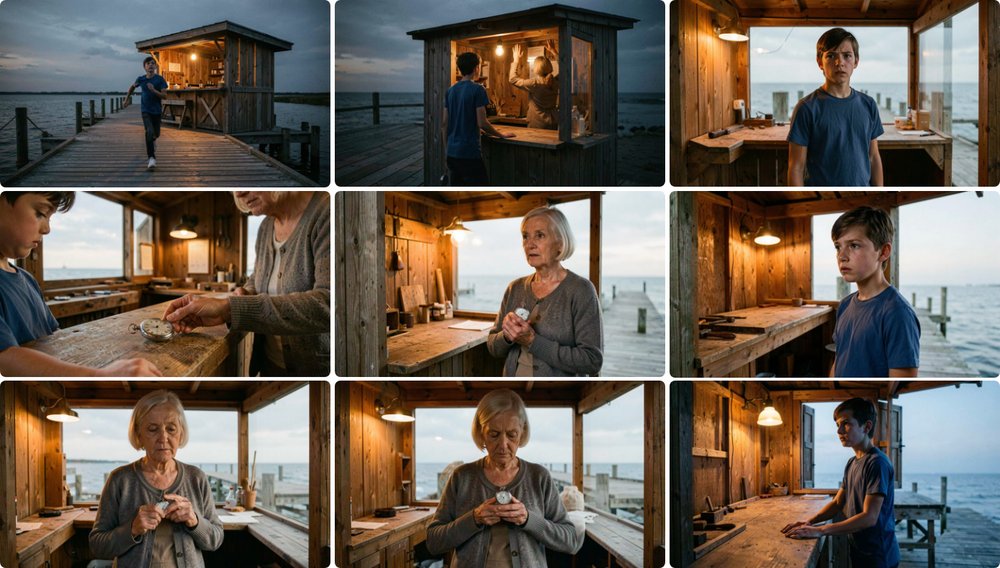
Today’s look: the pictures of the live film’s scene.
Now the copies. Each sheet shows one shot drawn in several ways, lettered A to D. The letters are a blind. Which letter is which look stays sealed until the studio’s owner has marked which pictures he prefers, so you can judge them the same way before you read the numbers.
Open the sheets of the copies, shot by shot

The first shot, as pictures lettered A to D. The letters are in a different order for each shot.

The second shot, as pictures lettered A to D. The letters are in a different order for each shot.

The third shot, as pictures lettered A to D. The letters are in a different order for each shot.

The fourth shot, as pictures lettered A to D. The letters are in a different order for each shot.

The fifth shot, as pictures lettered A to D. The letters are in a different order for each shot.

The sixth shot, as pictures lettered A to D. The letters are in a different order for each shot.

The seventh shot, as pictures lettered A to D. The letters are in a different order for each shot.

The eighth shot, as pictures lettered A to D. The letters are in a different order for each shot.
What did the colour measure say?
The table gives the share of each picture’s colour that is warm or cool, and how bright it is. The last column is the distance from today’s look, where zero means identical.
| Look | Warm share | Cool share | Brightness (level) |
|---|---|---|---|
| Today's look | 0.738 | 0.253 | 0.374 |
| Naturalistic, overcast | 0.558 | 0.428 | 0.333 |
| High-key, bright | 0.749 | 0.222 | 0.51 |
| One warm palette | 0.994 | 0.003 | 0.344 |
| Today's look again | 0.837 | 0.145 | 0.363 |
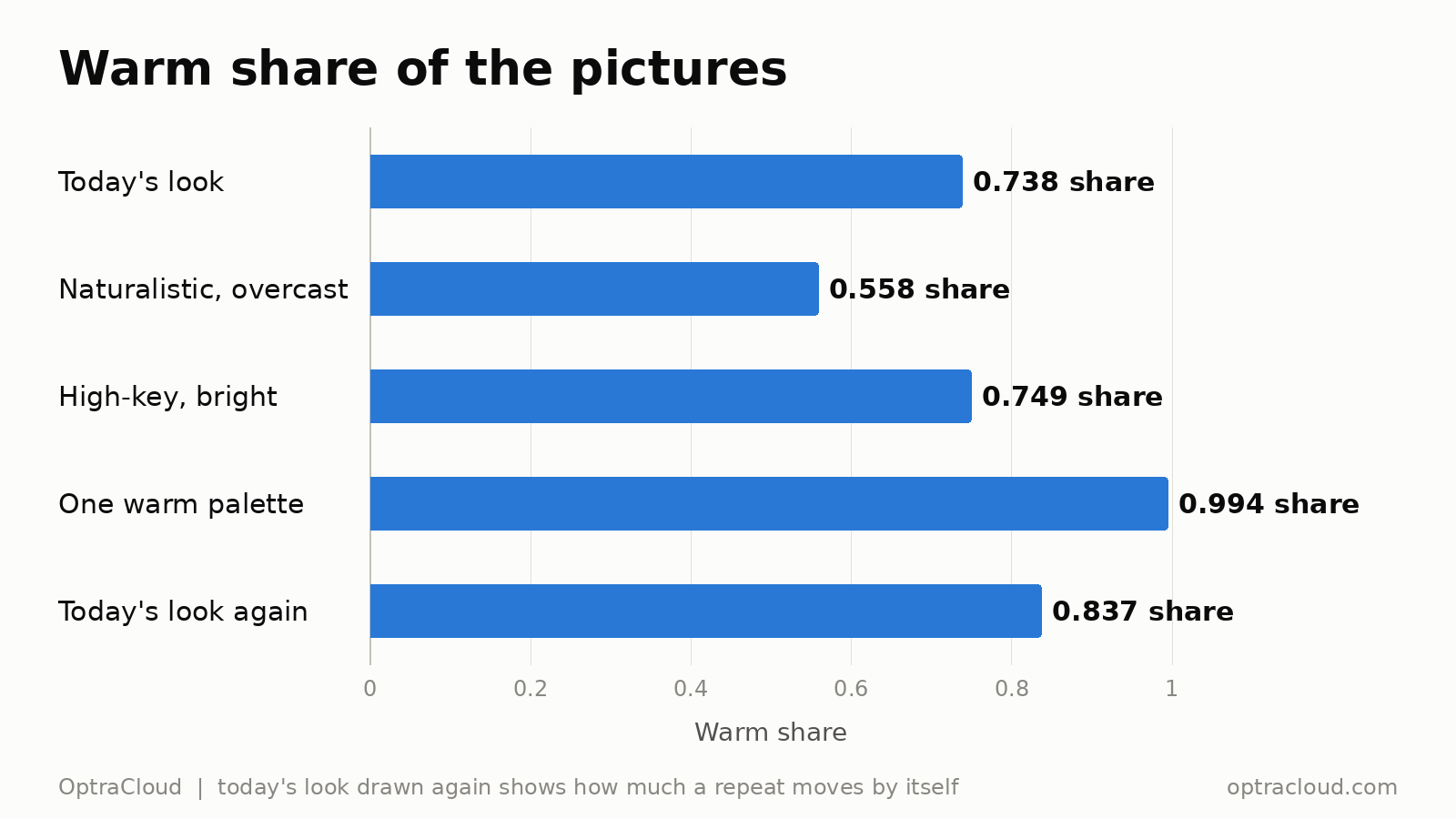
Warm share of the pictures
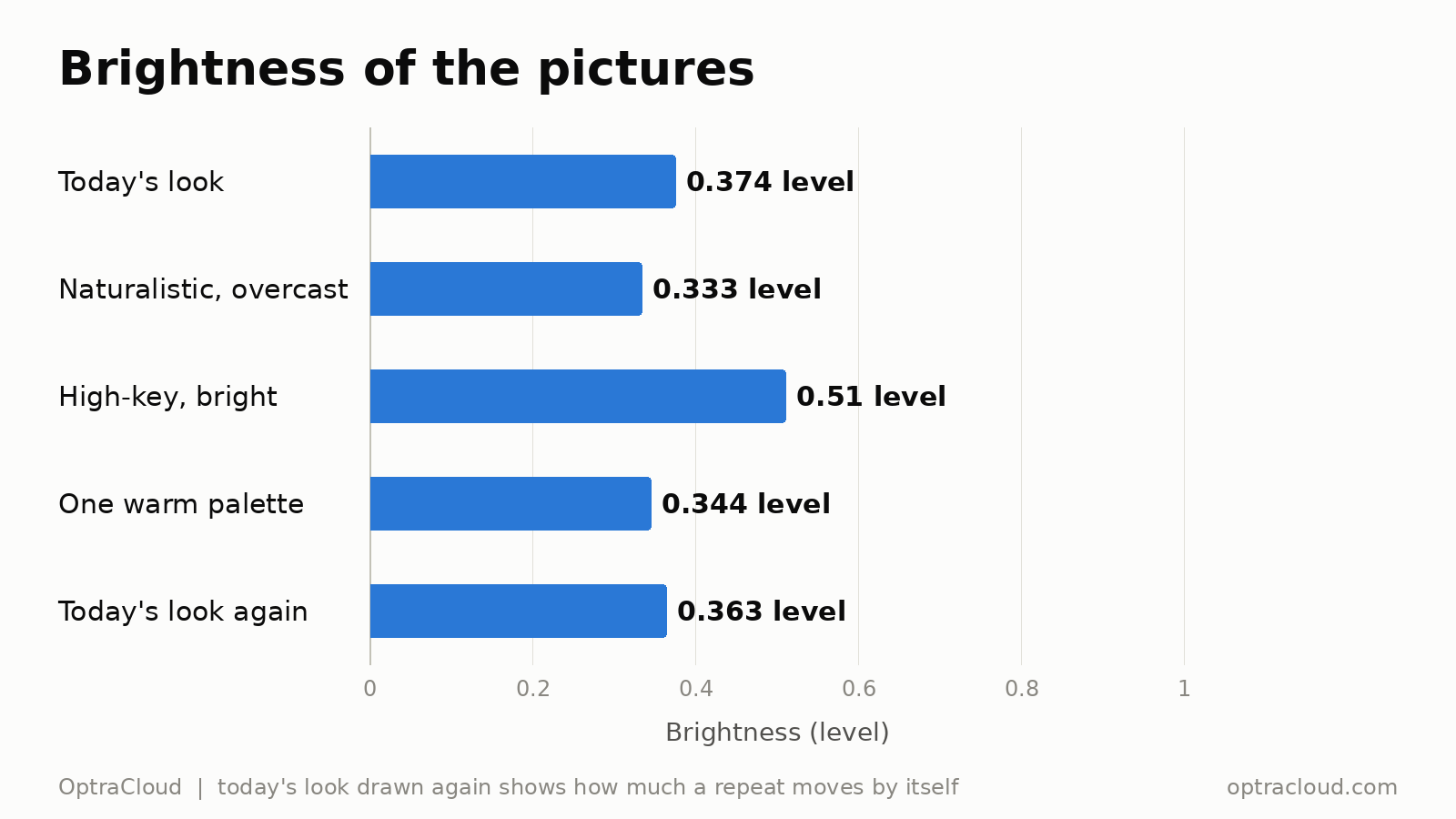
Brightness of the pictures
To share. Pictures of these numbers, made from the same record and sized for a phone:
How big is the noise?
A pair of draws of the same sentence differed by a distance of 0.125. The warm share moved by 0.1 between them, and the brightness barely moved, by 0.01. Every other change must be read against that.
What did each sentence do?
The naturalistic sentence left the pack. It was less warm and more cool, and its distance was 2.1 times the noise. That is a real move, but not an enormous one.
The high-key sentence changed the brightness clearly, from about 0.363 to 0.51. Its balance of warm and cool colour stayed inside the noise.
The warm-palette sentence moved the most, 2.6 times the noise. But it moved toward the look our films already share, and its nearest neighbour was one of our own films. A warm palette does not diversify. It joins the common recipe.
Did the studio change our sentence?
Yes. For the warm-palette copy, the text model that reads a brief rewrote our sentence. It dropped a few words and added the word “cinematic”. So that copy is not a clean test of one warm palette.
What did we not measure?
We drew each look once. Today’s look is the live film, with its own shots, and the noise comes from a single repeat. The pictures were small, and nobody has marked which look people prefer. The blind marks were never made.
What does this mean?
The look sentence is a real lever, and it can move a film’s colour about as far as twice the noise of redrawing. Measure the noise first, or you will read luck as effect. And do not trust a model to carry your sentence unchanged.
Quick Search Our Blogs
Type in keywords and get instant access to related blog posts.


