
Measured on 2026-11-07.
Baseline and change. The baseline is The old route. How a first draft was written before we told the writer to begin at once; it ran earlier the same afternoon.
The changes set against it:
- Begin at once
- Think first
In Optra Studio. This test has no page in Optra Studio: it ran typed ideas through the first-draft stage on the farm, and has no project page.
Telling the writer to begin at once gave the first words faster than leaving it to think first, in both runs of the same ideas. Both beat the old route. A blind read of the scripts is still to come.
What did we want to know?
A person types an idea, and we write the first draft of a script from it. We want the first words to appear in about 2.0 seconds, and the whole script in 10.0.
So we asked a plain question. Does telling the writer to begin at once help, or is it better to let it think first?
How did we test it?
We took 10 ideas. Most were short and in English, a few were in Hindi, and one was long. The same writer, Claude Opus 5.5, wrote each idea twice, once for each instruction. The order of each pair changed from idea to idea.
Our checks then read every draft. A draft that passes is stored. One that passes after a second try is repaired. One that fails is refused.
We ran the whole test, and then we ran it again with the same ideas. We call the second run the rerun.
What did we find the first time?
Beginning at once was faster in every measure. The first words came in a median of 3.47 seconds, against 5.93 for thinking first.
The slowest first words took 5.81 seconds, against 18.4.
The whole script took a median of 7.74 seconds, against 13.3.
The slowest script took 15.22 seconds, against 29.06. Our target was 10.0.
| Route, run, and which ideas | Ideas | First words, median (s) | First words, slow end (s) | Script, median (s) | Script, slow end (s) | Stored (drafts) | Refused (drafts) |
|---|---|---|---|---|---|---|---|
| Old route, all ideas | 10 | 11.85 | 33.52 | 15.37 | 41.92 | not measured | not measured |
| Old route, short English | 7 | 11.42 | 19.12 | 15.1 | 24.3 | not measured | not measured |
| At once, all ideas (first run) | 10 | 3.47 | 5.81 | 7.74 | 15.22 | 7 | 3 |
| At once, short English (first run) | 7 | 3.47 | 4.19 | 7.74 | 10.06 | 6 | 1 |
| Think first, all ideas (first run) | 10 | 5.93 | 18.4 | 13.3 | 29.06 | 8 | 2 |
| Think first, short English (first run) | 7 | 5.69 | 9.14 | 11.28 | 14.23 | 6 | 1 |
| At once, all ideas (rerun) | 10 | 2.07 | 3.1 | 6.99 | 12.56 | 10 | 0 |
| At once, short English (rerun) | 7 | 2.07 | 3.1 | 6.99 | 9.1 | 7 | 0 |
| Think first, all ideas (rerun) | 10 | 11.2 | 15.77 | 14.96 | 24.82 | 10 | 0 |
| Think first, short English (rerun) | 7 | 8.76 | 13.15 | 12.12 | 17.56 | 7 | 0 |
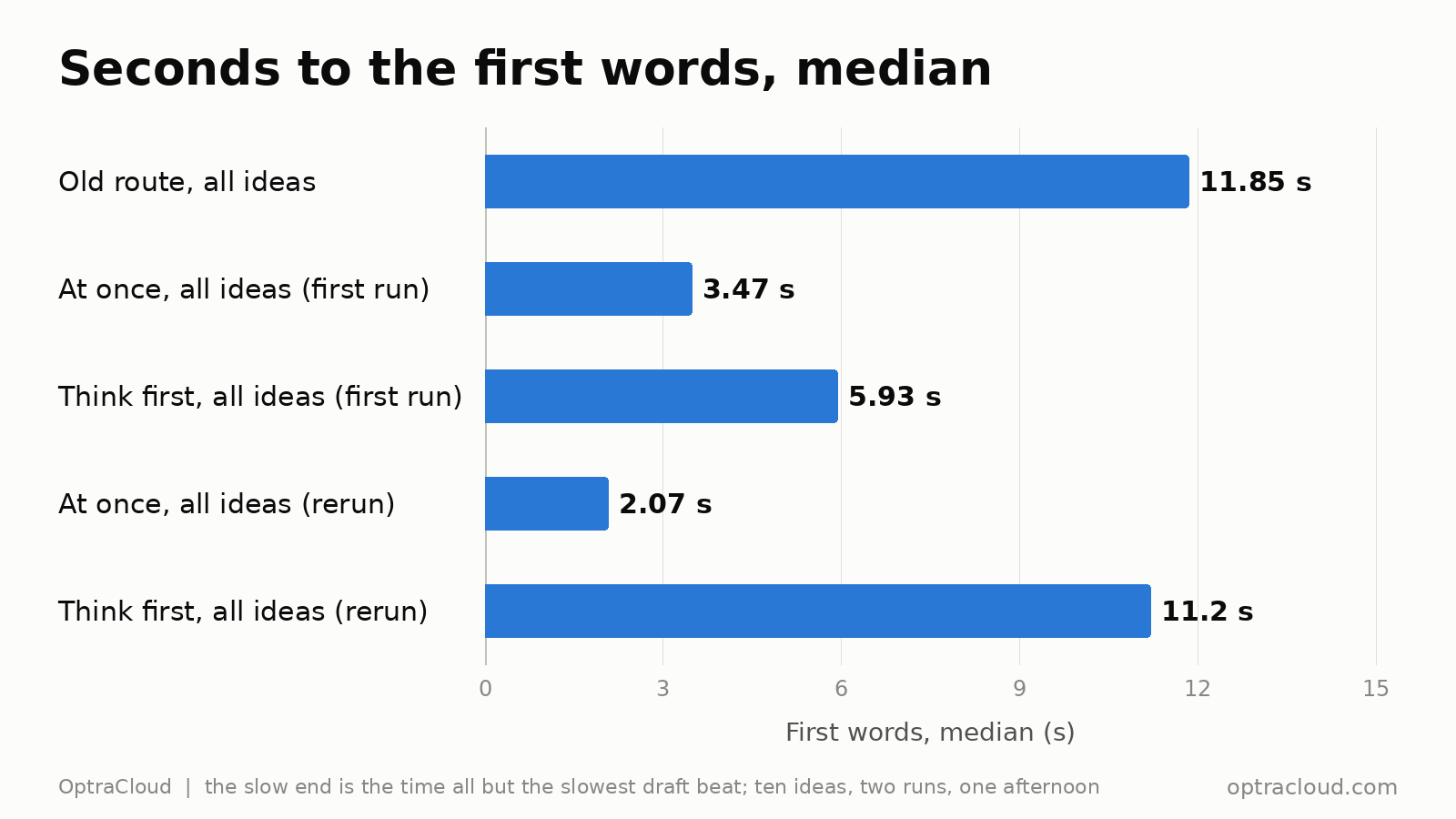
Seconds to the first words, median
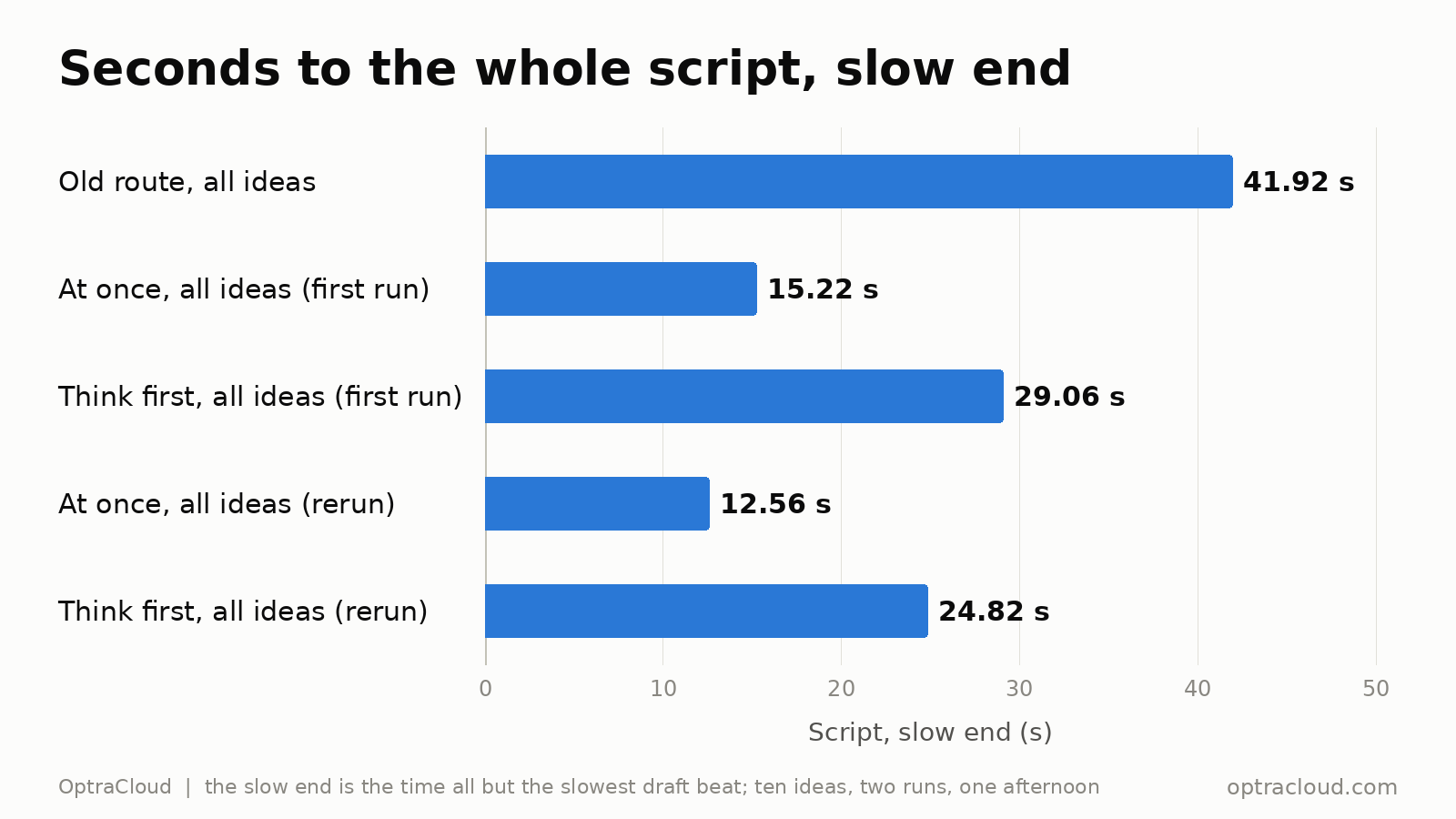
Seconds to the whole script, slow end
To share. Pictures of these numbers, made from the same record and sized for a phone:
What did the rerun show?
Beginning at once held up. The first words came in a median of 2.07 seconds, against 11.2 for thinking first.
The slowest first words took 3.1 seconds, against 15.77.
The whole script took a median of 6.99 seconds, against 14.96.
The slowest script took 12.56 seconds, against 24.82.
Our target for the whole script was 10.0 seconds. Beginning at once brought the median script inside it. The slowest script was still over.
Was it better than the old route?
Yes, by a lot. The old route, earlier that afternoon, gave first words in a median of 11.85 seconds. The slowest took 33.52.
Its slowest whole script took 41.92 seconds. Both new instructions cut this.
How many drafts passed our checks?
In the first run, beginning at once stored 7 drafts and refused 3.
In the first run, thinking first stored 8 and refused 2.
In the rerun, both ways stored every draft. Beginning at once refused 0, and thinking first refused 0.
Of the stored drafts in the rerun, 3 needed a second try when beginning at once, and 2 when thinking first.
Were the scripts as good?
We do not know. Nobody has compared the pair of scripts for each idea yet. They are kept side by side, in an order that hides which instruction wrote which, for a reader to judge.
A blind read of the scripts, side by side, comes before we change what the studio does. So this post is about speed, and it says nothing about which script reads better.
What did we not measure?
This is a small test. It used one writer, one machine and one afternoon, and only a few ideas in Hindi and one long idea. The slices of the table are too small to rank, so the table shows all ideas and the short English ideas.
The runs did not agree on every number. Thinking first took 5.93 seconds to the first words in the first run and 11.2 in the rerun. At this size the test cannot tell a small difference from chance.
We timed the work after the request reached our service. The wait before that is not counted. We also did not judge quality.
What does this mean?
Beginning at once held up on the rerun, so we keep it for now. The blind read decides whether it becomes the default. The slowest scripts still miss our target, so the next step is to find where the rest of the time goes.
Quick Search Our Blogs
Type in keywords and get instant access to related blog posts.