
Measured on 2026-09-02.
Baseline and change. The baseline is Qwen3.8-27B (INT4), the live model. The model we serve today. Muse Glimmer without speculation is the baseline for the two faster settings of it.
The changes set against it:
- Muse Glimmer 30B INT4 (no speculation)
- Muse Glimmer 30B INT4 (DFlash k=16)
- Muse Glimmer 30B INT4 (DFlash k=4)
In Optra Studio. This test has no page in Optra Studio: it measured a model on a bench, and has no project page.
No outputs to show. The answers the model gave are quoted in this post. We did not keep the test images or the full replies with our notes, so we cannot show them here.
The new model was real and a little faster than the one we use today, but some claims in the viral post about it were wrong.
What did the post claim?
A viral post said an open AI model from a big company was ready for anyone to run. It said the model fits in 24 GB of memory and runs at up to 233 tokens, which are small pieces of words, a second.
We checked each claim in the post against the maker’s own model page. Most held up. The ones that did not were about speed and size, which are what we would buy on.
| The claim | What we found |
|---|---|
| Fits in 24 GB | Only as a squeezed, compact version. The released files are 59.6 GB. |
| Runs at up to 233 tokens a second | That speed is on a different card, with a helper model attached. The maker’s own figure for that card without the helper is 74.9. |
Which exact model did we run?
We ran a squeezed, compact version of the model on a pair of RTX A5000 GPUs. The table gives the files. Our model list pins the maker’s original files to one exact version. Our notes do not record the exact version of the squeezed copy.
| What ran | |
|---|---|
| Model we ran | RedHatAI/Muse-Glimmer-30B-INT4 |
| Original model | meta-models/Muse-Glimmer-30B |
| Version of the original | a4e59da52a7bc87ae7251dd5545c0dd437c44b68 |
| Precision | INT4 (4-bit) |
| Ran on | two 24 GB graphics cards |
How fast is it against the model we use today?
Faster, by a little. Both ran on the same machine, with the same script, on the same day. We also did not expect it. Our first guess was only about 30 tokens a second, and we said it would fail our speed floor. It did not.
Our guess was wrong for one reason. We had scaled one of our GPUs against one of theirs. But we split the model across both GPUs, so they work together. A speed estimate for a split model must use their combined speed. Redone that way, it predicts 64.2, close to what we measured.
| Model | One request (tokens/s) | Many together, peak (tokens/s) |
|---|---|---|
| Qwen, our model today | 58.9 | 576 |
| Muse, plain | 62.1 | 681.4 |
| Muse + speed-up, short guesses | 89.8 | 285.5 |
| Muse + speed-up, long guesses | 62.2 | 98.5 |
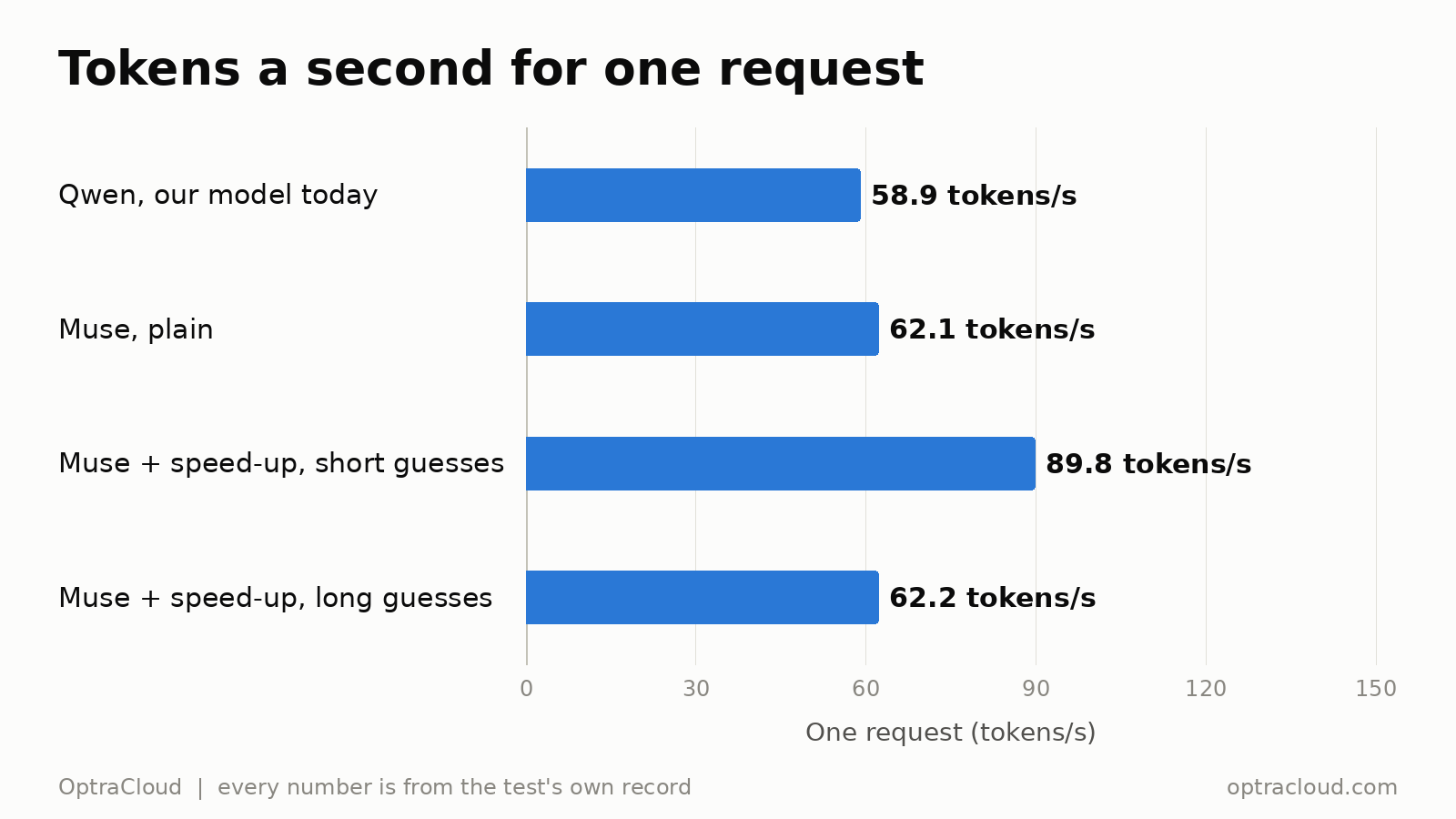
Tokens a second for one request
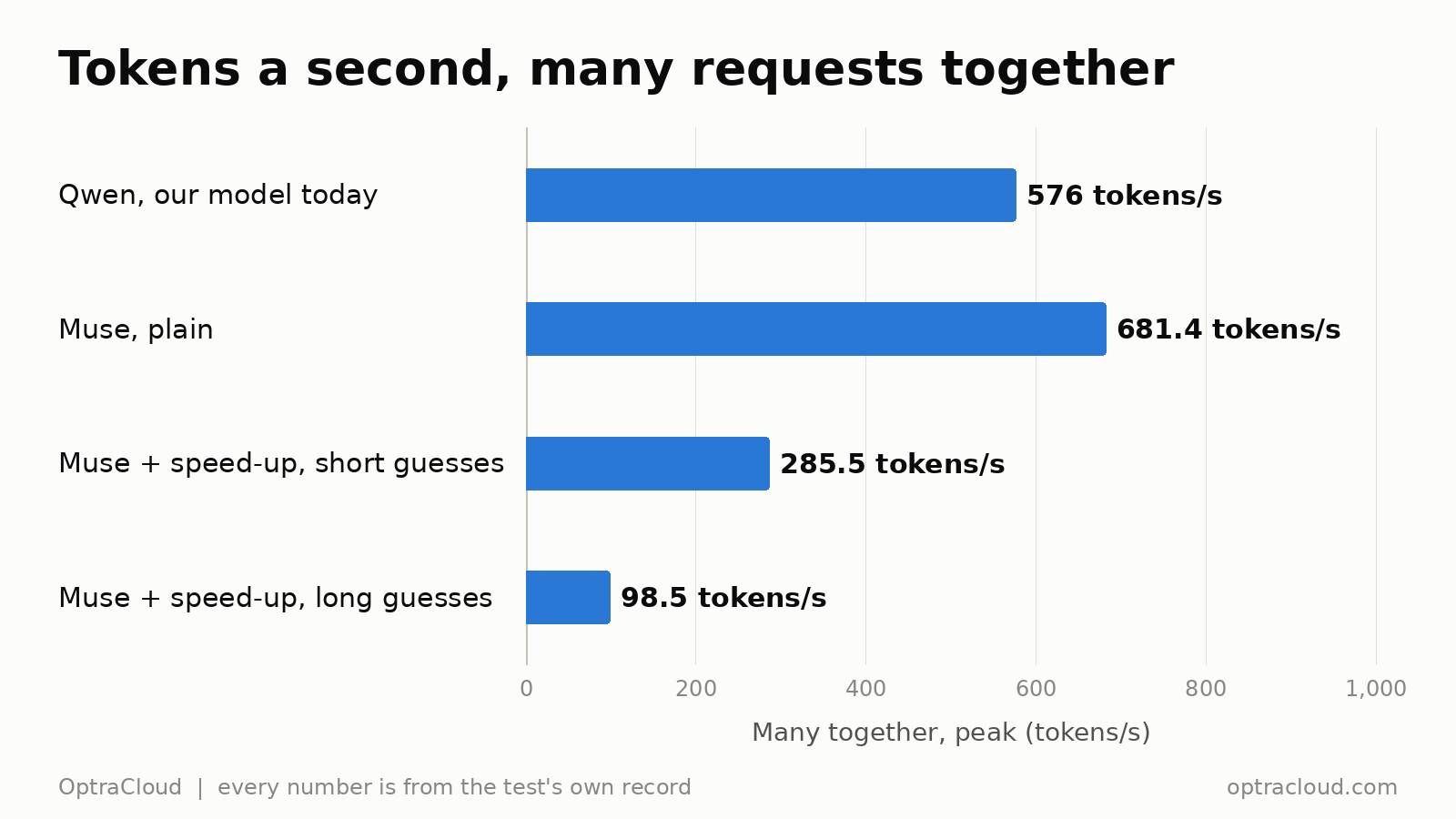
Tokens a second, many requests together
To share. Pictures of these numbers, made from the same record and sized for a phone:
Did the maker’s speed-up work for us?
The speed-up is a small helper model. It guesses several words ahead, and the big model checks the guesses. On the maker’s settings it did nothing for one request, and it was a disaster under load. Total output fell by about 6.9 times.
The helper ate the working memory. It shrank from 1,057,340 tokens to 218,973. The server could no longer hold enough requests to work on them together.
A smaller guess size did help one request: 89.8 tokens a second, a gain of 1.4 times. But it cut the total with many requests by 2.4 times.
A larger guess size of 8 would not even start. The server ran out of graphics memory.
Is it any good at the work?
We graded it by running the code it wrote against checks. It passed 8 of 11 in one test set.
In a set of real production problems, it passed 7 of 8.
Not every miss was the model’s fault. Most of the misses in the first set came from our own scoring script. One was a correct refusal that our script did not recognise, because it looked for “cannot find” and not “can’t find”. The other was a tool call that our script cut short.
One miss was the model’s own. It was asked to combine many small database queries into one, and it summed only one order for each customer.
What did it answer on the real tasks?
We also tested sight and tool use. Here is what it answered, word for word. It read the text in a test image, picked the tallest bar and remembered a colour from the third image in a row. It also called a tool with exactly the right numbers.
| What we asked | What the model answered |
|---|---|
| Read the text in the image | OPTRA-4271 |
| Which of the bars is tallest? | C |
| The colour in the third image | blue |
| Add some numbers with the tool | add({“a”: 8471, “b”: 2938}) |
Can you rely on it for tool calls?
Only if you keep its randomness low. With our script’s default settings, 4 of 20 tool calls were cut off before they finished. With randomness switched off, all 20 worked.
So the tool calls should be run at low randomness. At the default, a fair share of calls fail. For an agent that is a broken product.
What did we not measure?
This is one machine and one day. We did not run the maker’s own device, so we cannot check their number directly. We have no quality score for our current model on these same tasks. And our notes do not record the exact version of the squeezed copy.
What does this mean?
Read a viral claim as a set of separate claims, and test the ones you would buy on. Here the model was real and good for us. The speed number belonged to a different card, and the helper-model trick made things worse. Then check your own test script before you blame the model.
Quick Search Our Blogs
Type in keywords and get instant access to related blog posts.


