
Measured on 2026-08-31.
Baseline. This test has no baseline: it is not a side-by-side run of full models.
In Optra Studio. This test has no page in Optra Studio: it benches how GPUs talk to each other, and has no project page.
A pair of RTX 5090 GPUs can share one AI model, but they cannot pass data to each other directly. That costs a measured tenth to a quarter of the speed. A third or a fourth GPU runs into other limits first.
What did we want to know?
We asked how RTX 5090 GPUs talk to each other when one AI model is split across them. We also asked what that costs, and how many can work on a single model.
What did the machine say?
We asked a machine with a pair of RTX 5090 GPUs a handful of questions, using its own diagnostic tools. Open the table to read its answers, word for word.
The machine's six answers (6 rows)
| What we asked | What it answered | The note's comment |
|---|---|---|
| nvidia-smi nvlink -s | "Device does not have or support Nvlink" (both) | |
| nvidia-smi topo -m | PXB (never NV#) | |
| nvidia-smi topo -p2p r | CNS / CNS (Chipset Not Supported) | |
| power.min_limit | 400 W both | no Max-Q escape |
| pcie.link.width | max 16, current 8 | bench-box artifact |
| Replays Since Reset | 0 on both | electrically clean |
What does that mean?
There is no fast direct link between the GPUs, and they cannot read each other’s memory. Every byte they exchange goes through the computer’s main memory. The AI server software says so in its log: “Custom allreduce is disabled because your platform lacks GPU P2P capability.”
It is taxed, not broken. The GPUs still work together.
How big is the tax?
We measured how long one small exchange needs. A direct exchange inside one GPU needs 7.1 microseconds. The table gives the rest.
| Kind of exchange | Time (microseconds) |
|---|---|
| Inside one GPU | 7.13 |
| From a GPU to main memory | 11.27 |
| From main memory to a GPU | 11.56 |
| A plain exchange between GPUs | 62.5 |
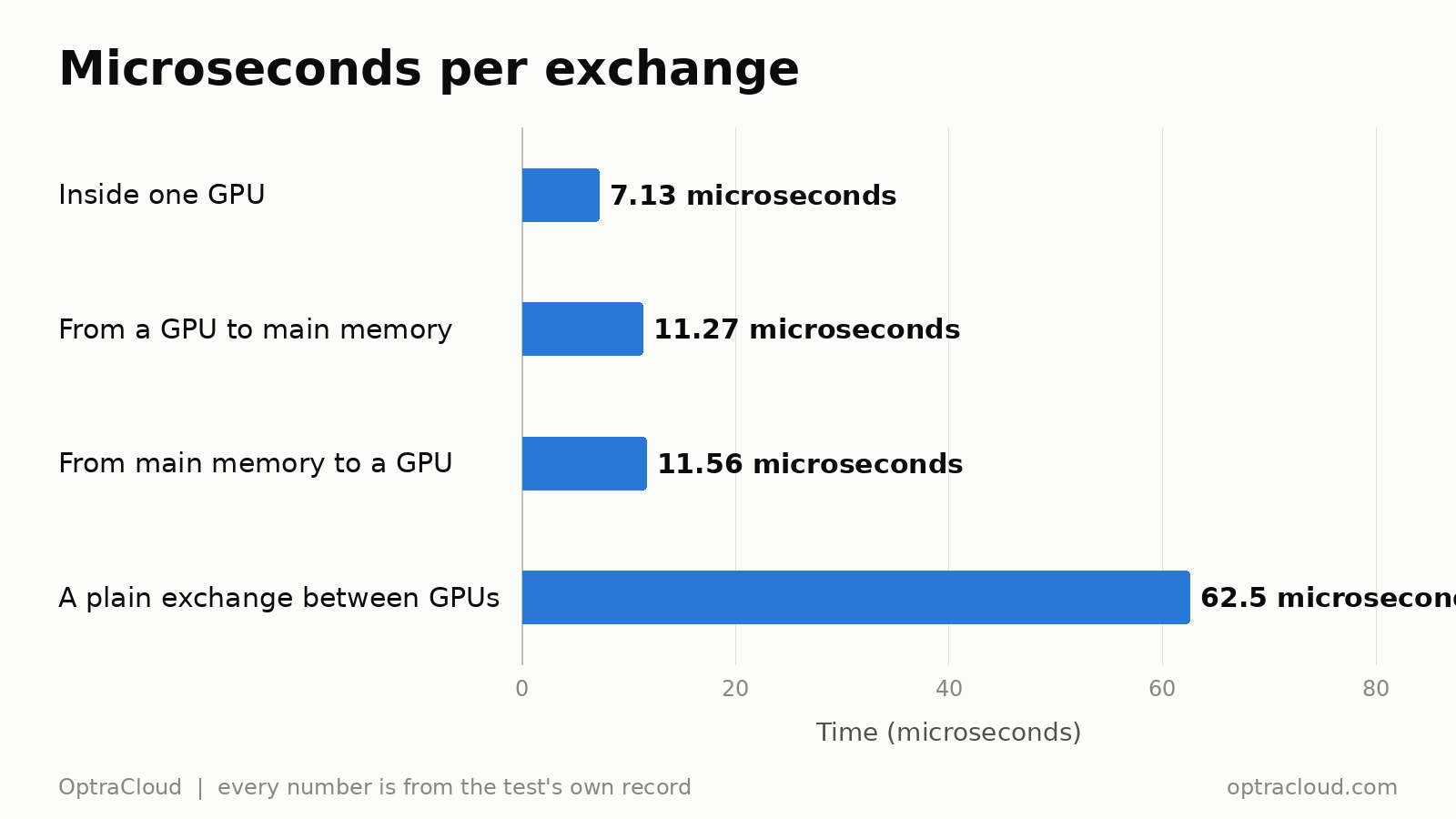
Microseconds per exchange
To share. Pictures of these numbers, made from the same record and sized for a phone:
What does that cost for each word?
Writing one word needs about 128 such exchanges. The extra delay comes to about 2 milliseconds a word.
That is about 13 percent of a 16.7-millisecond budget.
Outside checks agree. A bigger workstation card measured 90 words a second with a direct link and 70 without one.
What about reading a long prompt?
It is worse. The staged path moved 17.1 GiB a second where the main memory reached 26.5.
The delay before the first word grew by about 2.5 to 3 times against a direct, full-width link.
How many GPUs can work on one model?
A trio of GPUs cannot share it evenly. This model has 4 groups of attention heads. The work can only be split into whole shares of that: a single GPU, a pair, or 4.
4 GPUs run into space next. Retail RTX 5090 GPUs are about 3.5 to 4 slots thick.
That many need 14 to 16 slot positions, and a server box of the size we considered has about 8.
What did we not measure?
We used one bench machine. Its link ran at half width, which comes from that machine’s motherboard and not from the GPUs. We left out prices and any advice about buying.
What does this mean?
A pair of GPUs is a practical way to share one model, and the missing direct link is a real but modest cost. Beyond that, the limits are the model’s shape and the box, not the GPUs themselves. Ask what the link between your GPUs can do before you count on them.
Quick Search Our Blogs
Type in keywords and get instant access to related blog posts.