
Measured on 2026-08-29.
Baseline and change. The baseline is The hosted H3 run, as the vendor reports it. The vendor's own timing for the hosted model; the open-weights runs are set against it.
The changes set against it:
- MiniMax H3 (8x B300, FP8)
- MiniMax H3 (2x RTX 5090 32GB, TP2 + layerwise offload)
No outputs to show. This was a desk study of the maker’s public pages and guides. We ran no clips, so we have no outputs of our own to show. Every time in the table comes from the maker’s own guide, which we recomputed.
The fast video model you can rent cannot be downloaded, and the open model you can download is far slower than real time, even on the biggest hardware.
What did we want to know?
A post on social media said a new AI model could make video faster than you can watch it. We asked a plain question. Could we run it on our own machines, and what would that take?
This is a desk study. We read the vendor’s public pages and guides, and we recomputed every ratio from the raw seconds. We did not run the model ourselves.
What does “Max” mean?
It does not mean bigger. In this case it means faster. The hosted version called H3 Max makes shorter, lower-resolution video than the open model called MiniMax H3.
A hosting company built H3 Max on top of the open model, and hosts it itself. The model’s maker also resells a version with the same name. We could not find out whether both are the same files.
Can you download the fast one?
No. There are no files to download. This is not a memory problem. The files simply do not exist.
The maker’s page on the model hub lists 21 models, and none is H3 Max. The maker’s own 46 KB guide to running models at home never mentions it.
How fast is the claim?
The hosting company says a clip of 5 seconds renders in under 3 seconds. That is faster than real time.
There are some catches. The claim holds only for short clips: a clip of 15 seconds needs about as long as it plays. It is the vendor’s own number. And it runs on rack-sized hardware, not on a card you can buy.
How fast is the model you can download?
The open model is called MiniMax H3. The vendor’s guide measured it making a clip of just over 5 seconds on several machines. Here is what it found.
Nothing open is close to real time. Even the biggest machine in the table is several times too slow.
| Machine | Seconds for the clip (s) | Slower than real time (times) |
|---|---|---|
| 8x B300, FP8 | 18.03 | 3.5 |
| 4x H200 | 85.49 | 16.5 |
| 2x RTX 5090 32GB | 559.67 | 108 |
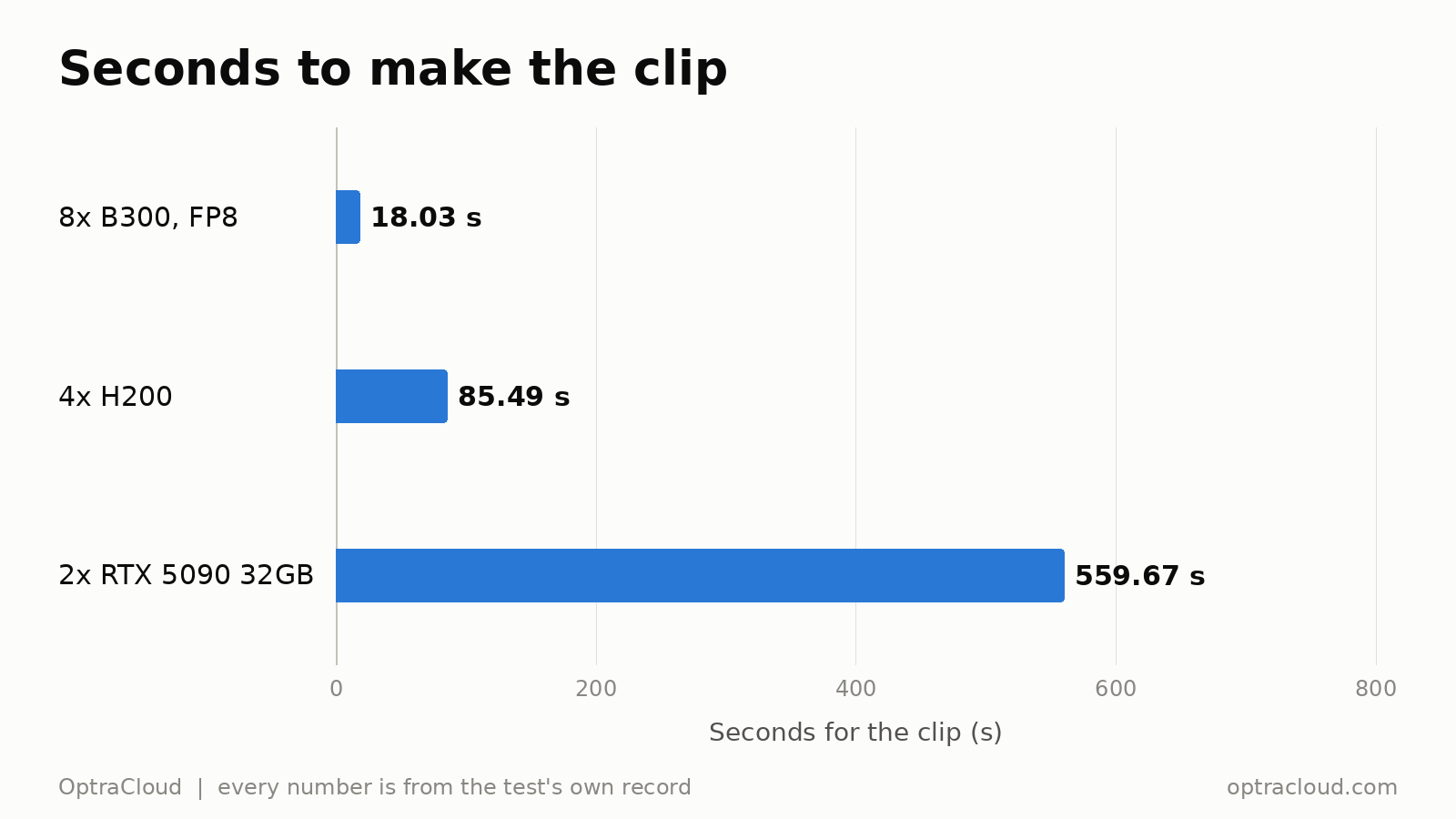
Seconds to make the clip
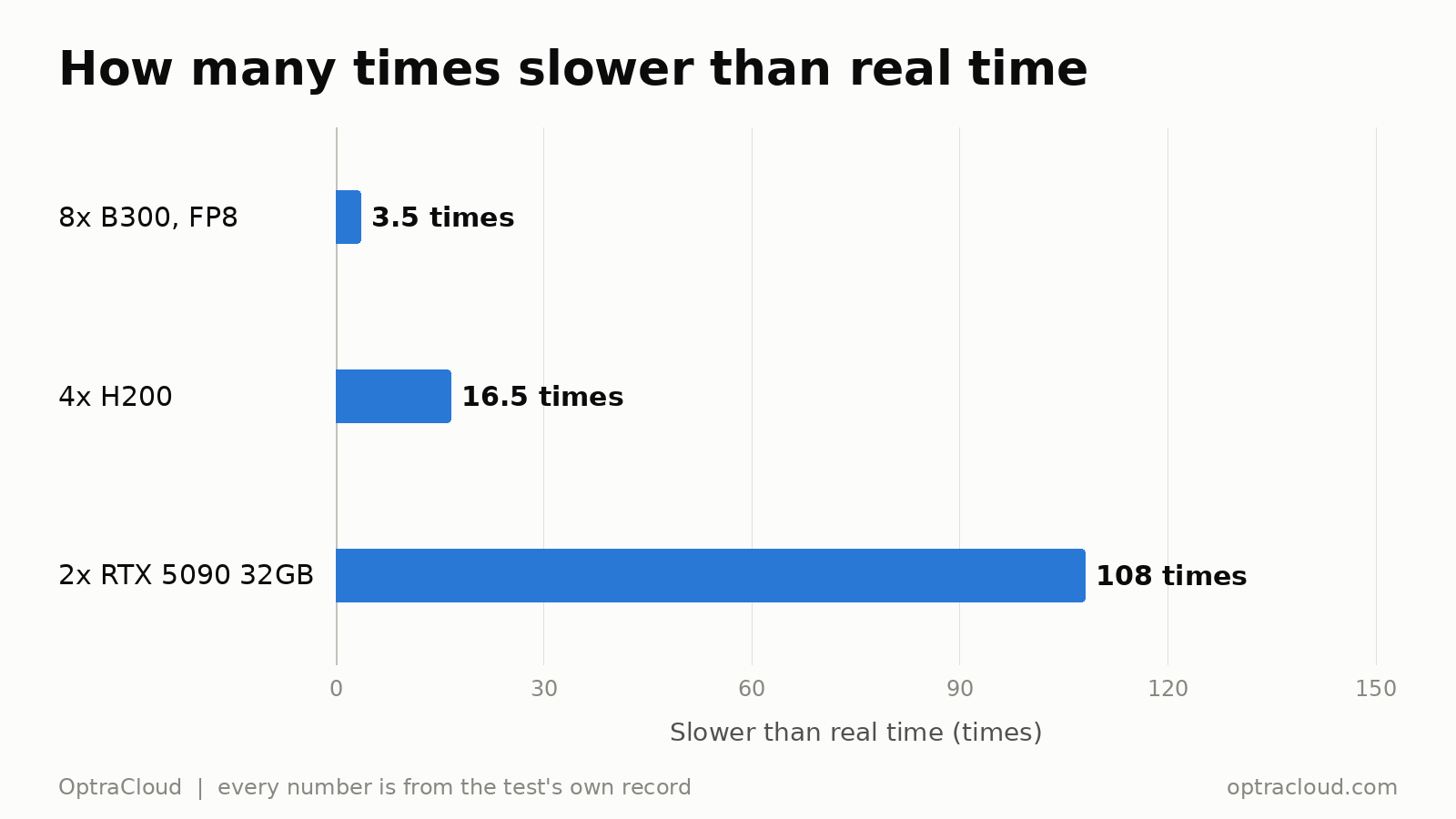
How many times slower than real time
To share. Pictures of these numbers, made from the same record and sized for a phone:
Could we run it on our own GPUs?
Not the ones we own. Our pair of RTX A5000 GPUs is on no published path for this model, so we did not plan on it.
What did the checking change?
We had a sweep of reading agents do the first pass, and then more agents checked every important claim. The checks changed some conclusions.
First, our first pass blamed the wrong company for the fast model. Second, we had been carrying an old belief that this maker keeps its video models closed. That belief was out of date, because it had released open files.
What did we see in our own clips from this model?
We have also looked at clips that this model drew for us, from one of our own test films. This is a small read of a few clips by people, not a measure.
The films producer read a contact strip of each clip, with one frame every 0.25 seconds. We then looked at the frames at the times the producer named.
In shots 5, 8 and 9 the setting changed inside the clip: the picture of one place became another, without the camera or the person moving there. The pier gave way to the inside of the ferry.
In shot 5 it is a cross-dissolve: the inside of the ferry is laid over the pier from 0.25 to 1.00 seconds.
In shot 8 it is a hard cut, between 0.00 and 0.25 seconds. The man walking toward the camera is next seen from behind, on a different stretch of deck.
In shot 9 it is a cross-dissolve, from 4.00 to 4.75 seconds, from the pier side of the ferry to its inside.
A different fault was seen in shot 3: a ship placed wrongly over the dock. So 4 clips were read, and each had a setting or placement fault. Our team also saw a face on the dock that is not clear, and a walking face that shimmers from frame to frame.
That is all we know. We do not know how many clips of our project, or of this model, do this. We did not test whether the cause is the model, our words or our still.
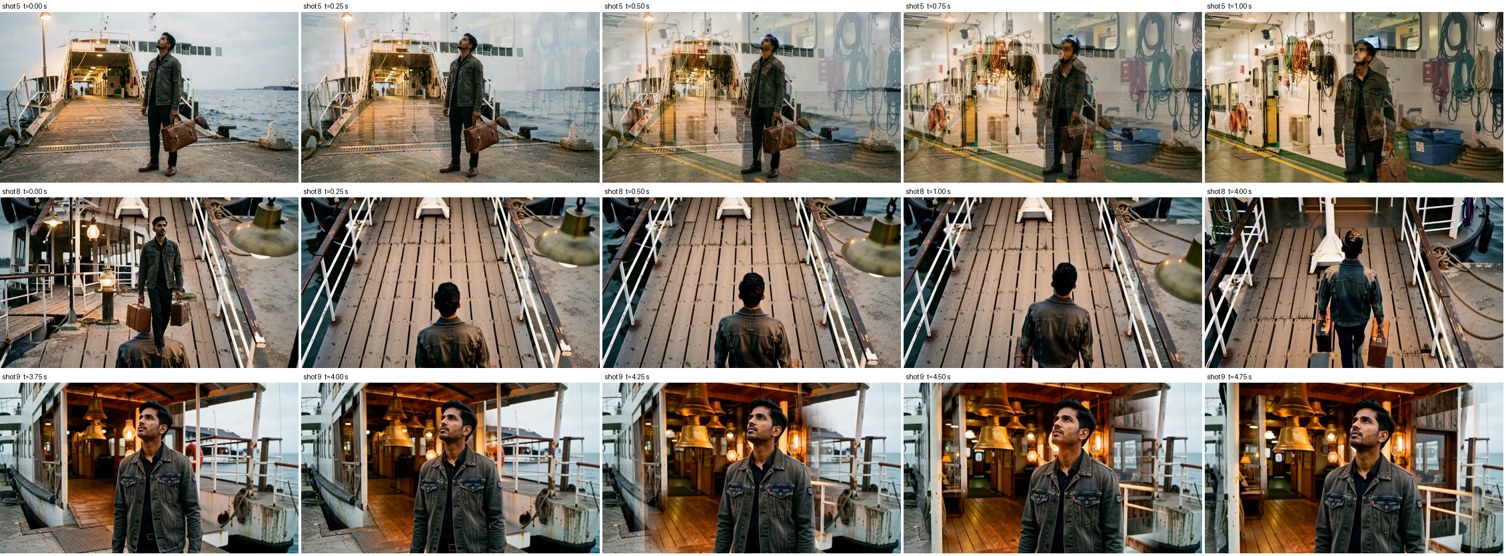
Frames at the times named above, one row for each clip: the setting changes from the pier to the inside of the ferry.
Shot 5, as the model drew it: the pier dissolves into the ferry’s inside near the start.
Shot 8, as the model drew it: a hard cut almost at once.
Shot 9, as the model drew it: the setting dissolves near the end.
What did we not check?
We never saw the livestream that the post mentioned, so we cannot say whether video can really be made without end. We also do not know whether the hosted speed claim covers the whole trip, or only the model’s own work.
The open model’s licence limits where it can be used and where its output can be shown. We read that carefully, but a lawyer has not. Please do not treat our reading as legal advice.
What does this mean?
Faster than real time comes from a trimmed-down model and rack-sized hardware. It is not something a card purchase reaches. If you need that speed, you rent it.
The open model has another strength. It makes sound that matches the picture, in stereo. For us, that is its real draw, not speed.
Quick Search Our Blogs
Type in keywords and get instant access to related blog posts.