
Measured on 2026-11-08.
Baseline and change. The baseline is HyperFlow on an RTX 5090, in a bigger file (Q8_0), given as numbers only. It is the same model drawn on our big card. Its clip is one of a set that our team has still to mark blind, so the clip follows once the marks are in.
The changes set against it:
- HyperFlow on an RTX 5060 Ti, in a smaller file (Q4_K_M)
HyperFlow H3 Flash ran on an RTX 5060 Ti, and its loader read the file. But a short clip took longer than the MiniMax H3 we already run on the same card, and a longer clip did not finish in half an hour.
What did we want to know?
HyperFlow H3 Flash is a smaller version of MiniMax H3, the video model we use. Its big file needs a big card, so we tried a smaller file on a card with 16 gigabytes of memory, an RTX 5060 Ti.
We asked plain questions. Can it run there at all? How long does a clip take, and how much memory? And how does that stand against the same model on an RTX 5090, and against the MiniMax H3 we already run on this card?
What is the baseline?
The baseline is the same model, HyperFlow, drawn on an RTX 5090 in a bigger file called Q8_0, which is 14.9 gigabytes. The change is the smaller file, called Q4_K_M, on the RTX 5060 Ti.
The baseline took 103.9 seconds for a clip, in one cold run, with a peak of 20.4 gigabytes.
We give the baseline as numbers only. Its clip is one of a set that our team has still to mark blind, and showing it would give away which clip is which. The clip follows once the marks are in.
How did we test it?
One card, one still, one set of words and one set-up, for every run. A clip is 1,344 by 768 pixels at 24 frames a second.
A short clip, of 5 seconds, has 124 frames.
A longer clip, of 9 seconds, has 226 frames.
The first run is cold: the first time the card loads the model. A warm run is a repeat with the model already loaded. Each repeat asks for a new seed, so a repeat cannot be answered from a cache.
Did it run?
Yes. The loader read the smaller file in every run, with no failure. That was the open question of the test, and the answer is yes.
How long did a short clip take?
A clip of 5 seconds took 463 seconds cold and 444.4 seconds warm.
The peak memory of the cold run was 13.7 gigabytes. We give no peak for the warm run, because the card still held memory from the cold run.
The baseline’s peak was 20.4 gigabytes on the bigger card. That is a different card and a bigger file, drawn once in another measure, so its seconds are not a like-for-like speed. We do not say how many times slower the smaller card is.
| Model, card and run | Seconds (s) |
|---|---|
| HyperFlow, RTX 5060 Ti, cold | 463.0 |
| HyperFlow, RTX 5060 Ti, warm | 444.4 |
| MiniMax H3 turbo, RTX 5060 Ti, cold | 388.4 |
| MiniMax H3 turbo, RTX 5060 Ti, warm | 364.2 |
| Baseline: HyperFlow, RTX 5090, cold | 103.9 |
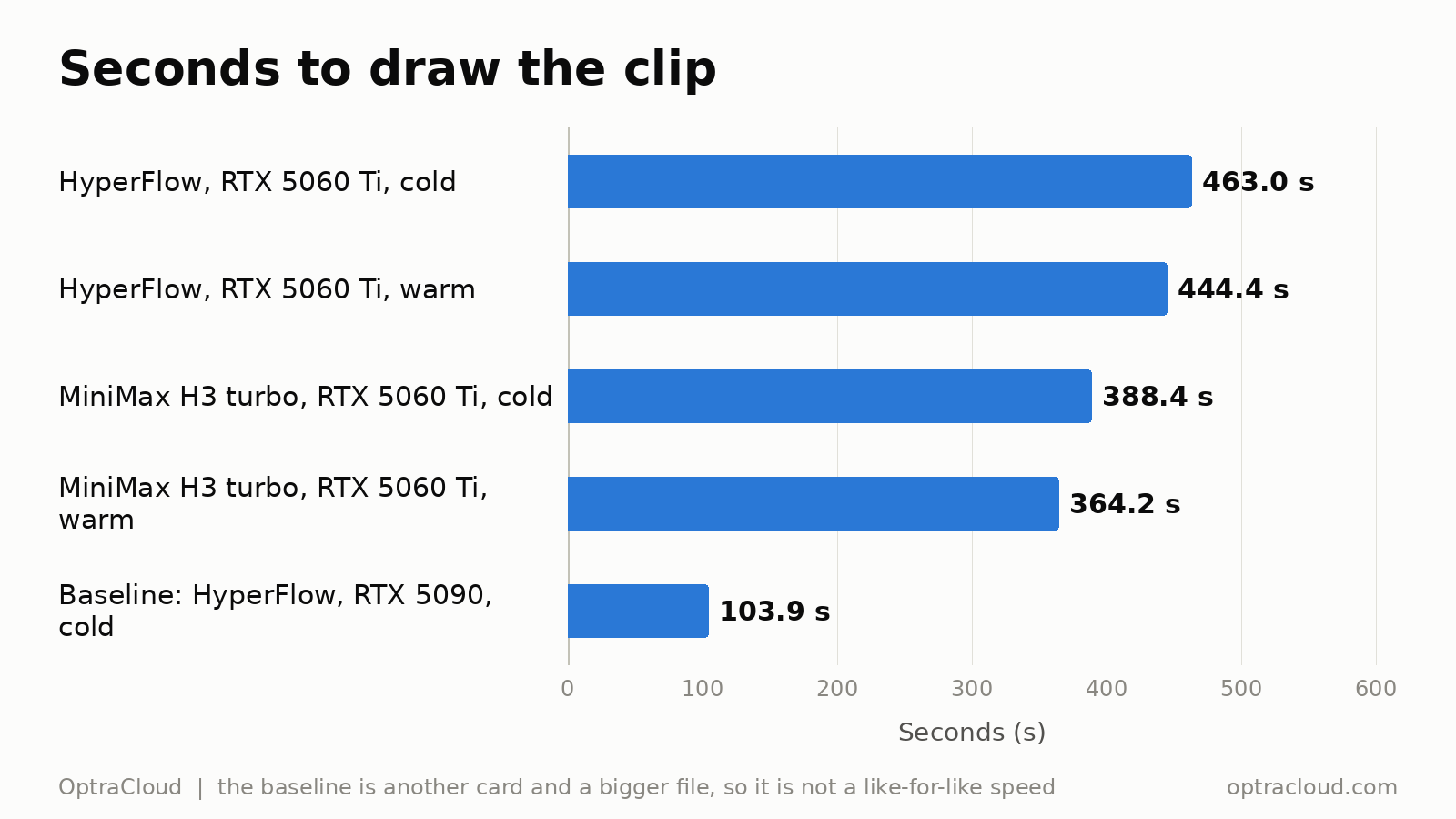
Seconds to draw the clip
To share. Pictures of these numbers, made from the same record and sized for a phone:
How does it stand against the MiniMax H3 we already run?
We already run MiniMax H3 on this card, in its turbo set-up. An earlier test of ours timed it on the same card at the same sizes, though not in the same measure.
It took 388.4 seconds cold and 364.2 seconds warm for the same clip length.
HyperFlow took 19 percent longer cold and 22 percent longer warm. That is the opposite of what its design promised on paper.
This is one clip length, a pair of runs and one card. It is not a verdict on the model.
What happened with a longer clip?
Neither run of the clip of 9 seconds finished inside our bound of 1,800 seconds, which is 30 minutes. So there is no time for it and no clip.
In that earlier test, the MiniMax H3 we already run drew the same clip in 908 seconds warm. We do not know why HyperFlow did not finish, and we chose not to retry it.
What did we see by eye?
One reader looked at 8 frames in all, spread across the length of the clips of 5 seconds. This is a spot check, not a panel.
Both clips keep one scene and one man. He stands on a pier with a bag and a ferry behind him, looks up, and has turned toward the camera by the later frames.
The face is too small at this size to judge, so we say nothing of it. No tearing or missing limb showed in the frames we looked at. A few stills cannot show flicker or motion, so we say nothing of those either. The clips carry sound.

Frames from each clip, spread across its length: the first run on the top row and the second run on the bottom row.
Watch the clips
Here are the clips of 5 seconds from the RTX 5060 Ti, the first run and then the second. The baseline’s clip follows once the marks are in.
The first run, cold: HyperFlow in the smaller file on the RTX 5060 Ti.
The second run, warm, on a new seed: the same set-up.
How much card time did this use?
We had planned about 28 minutes of card time for the whole test, and it used about 75. Both runs of the longer clip ran to the bound.
The runs of the short clip took about 15.5 minutes, and the runs that did not finish took 60. Our estimate did not allow for a second round repeating the first round’s timeout.
That was our mistake. We have changed the measure so that the repeats of a clip end once one round has run to its bound.
What did we not measure?
We did not compare the picture of the smaller file with that of the bigger one, so we say nothing about which looks better. We did not look at faces. And there is no time for the longer clip.
The baseline is a different card and a different file, so the speed of one against the other says little. We give only what each card did.
What does this mean?
HyperFlow runs on an RTX 5060 Ti, and the loader works. But for a short clip the MiniMax H3 we already run is the quicker choice on this card, and a longer clip did not finish in half an hour.
We chose not to retry the longer clip, so there is no time for it. On these runs, HyperFlow is not a win on this card.
Quick Search Our Blogs
Type in keywords and get instant access to related blog posts.


