
Measured on 2026-11-07.
Baseline and change. The baseline is The original clip. The clip as the film maker drew it, before any upscale; each size of the restorer is set against it.
The changes set against it:
- SeedVR2 3B (int8)
- SeedVR2 7B (fp16)
In Optra Studio. The test film's project, whose own clips are the originals, in Optra Studio
These pages open for the people who work on the project. For anyone else they may show a sign-in page, or a note that the page is not theirs to open.
Run on a whole clip, the restorer ran out of memory, or ran out of time. Cut into pieces in time, both sizes finished on one gaming GPU.
What did we want to know?
Our film maker draws clips at 1344×768. We want a sharper copy at twice the size, 2688×1536, without drawing the clip again.
A video restorer called SeedVR2 can do that. It comes in a small size, the 3B, and a large size, the 7B. We asked a plain question: do they fit on one gaming GPU, how long do they take, and how close is the result to the clip it came from?
Which exact files did we run?
Both sizes come from one repository at one revision. The table gives the exact files and their size in bytes.
| What ran | |
|---|---|
| Repository | Comfy-Org/SeedVR2 |
| Revision | df48879708206a403d2a61acd55578c2e80fd233 |
| Small size file | seedvr2_3b_int8_convrot.safetensors |
| Small size bytes | 3,458,259,704 |
| Large size file | seedvr2_7b_fp16.safetensors |
| Large size bytes | 16,480,583,960 |
How did we test it?
We took clips from our own test film: one with a clear face, one wide shot and one with fine texture. Each clip lasts 8 seconds, which is 192 frames. Every run used the same seed, on one gaming GPU with 32 GB of memory.
We tried each size on the whole clip first. Then we tried again with the clip cut into pieces in time, using ComfyUI’s own way of doing it.
What happened to the whole clip?
The small size ran out of memory on every clip. The large size ran out of memory on most of them.
On the remaining one, the large size gave no result within our limit of 1,800 seconds. So whole clips did not work at this size.
For a run that failed, the seconds in the table are the time until it stopped.
What happened when we cut the clip into pieces?
Both sizes finished on every clip. On the clear-face clip the small size peaked at 10,390 MB of the card’s memory, and the large size at 22,318 MB.
These peaks include what the card already held. Before its job started the card held 717 MB for the small size and 4,495 MB for the large.
| Size and way | Finished | Seconds (s) | Peak memory (MB) | Already held (MB) | PSNR (dB) | SSIM (index) |
|---|---|---|---|---|---|---|
| 3B, whole clip (clear face) | fail | 199.5 | not measured | not measured | not measured | not measured |
| 7B, whole clip (clear face) | fail | 1,801.6 | not measured | not measured | not measured | not measured |
| 3B, whole clip (wide shot) | fail | 206.5 | not measured | not measured | not measured | not measured |
| 7B, whole clip (wide shot) | fail | 2.9 | not measured | not measured | not measured | not measured |
| 3B, whole clip (fine texture) | fail | 215.2 | not measured | not measured | not measured | not measured |
| 7B, whole clip (fine texture) | fail | 2.9 | not measured | not measured | not measured | not measured |
| 3B, in pieces (clear face) | pass | 719.6 | 10,390 | 717 | 32.661 | 0.93916 |
| 7B, in pieces (clear face) | pass | 549.7 | 22,318 | 4,495 | 34.916 | 0.96359 |
| 3B, in pieces (wide shot) | pass | 710.3 | not measured | 16,945 | 30.774 | 0.92014 |
| 7B, in pieces (wide shot) | pass | 542.7 | 23,741 | 4,495 | 33.491 | 0.95385 |
| 3B, in pieces (fine texture) | pass | 707.6 | not measured | 16,945 | 32.25 | 0.93795 |
| 7B, in pieces (fine texture) | pass | 540.4 | 24,030 | 4,495 | 34.928 | 0.96393 |
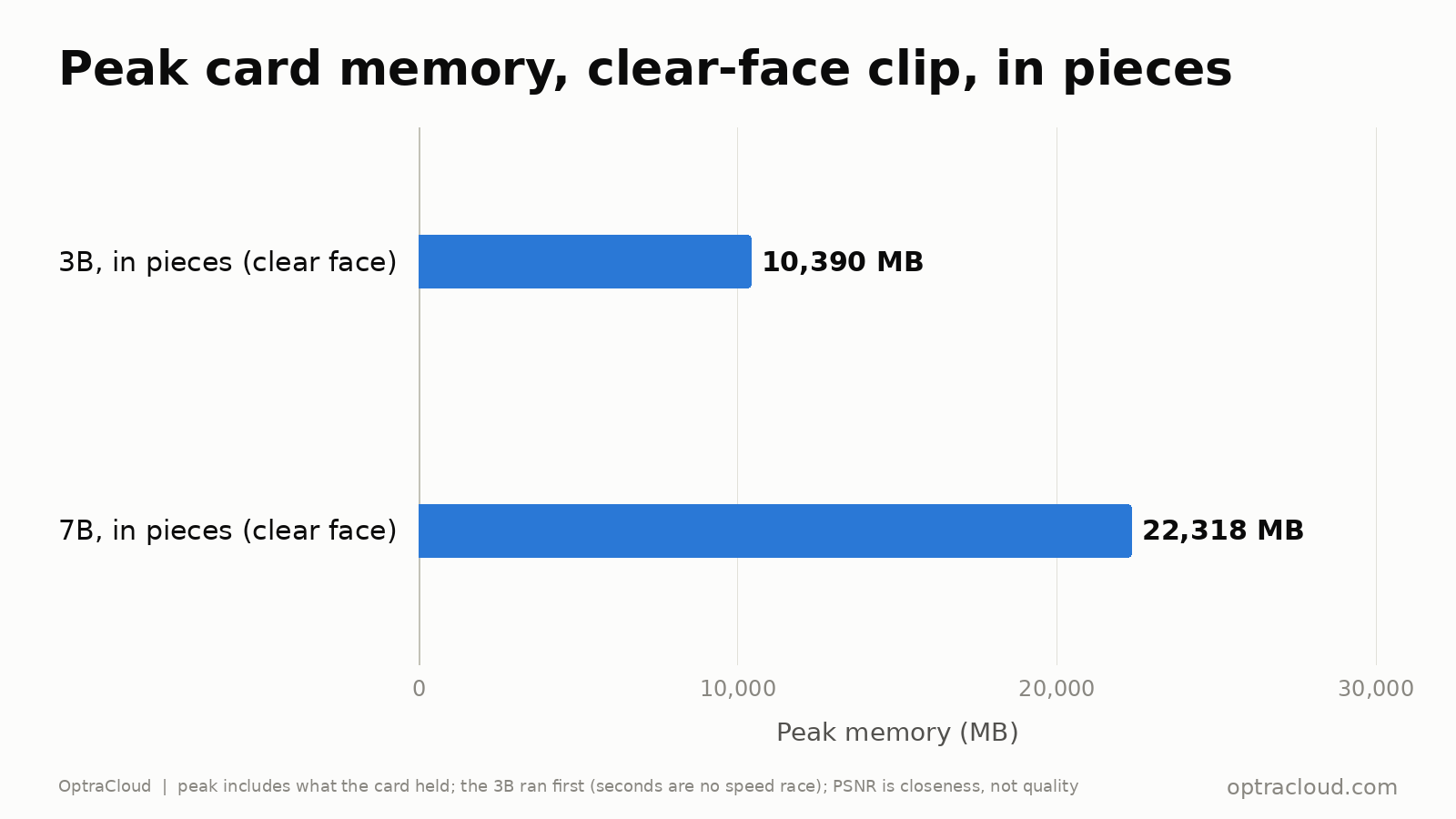
Peak card memory, clear-face clip, in pieces
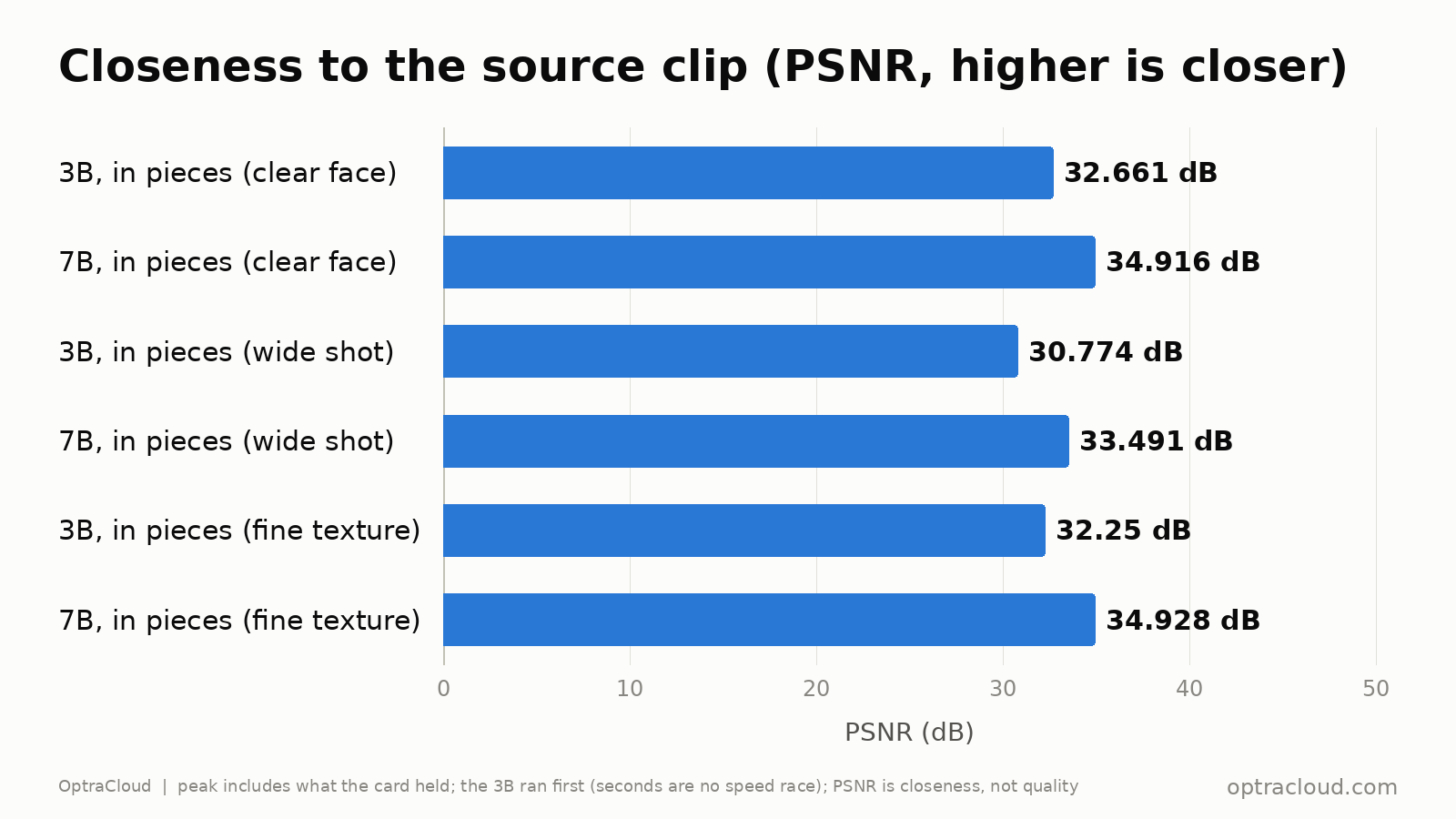
Closeness to the source clip (PSNR, higher is closer)
To share. Pictures of these numbers, made from the same record and sized for a phone:
- The table
- Peak card memory, clear-face clip, in pieces
- Closeness to the source clip (PSNR, higher is closer)
How close is the result to the clip it came from?
We scaled every frame of each result back down and compared it with its source, for all 192 frames. A higher score means closer. On the clear-face clip the small size scored 32.661 on one scale and 0.93916 on the other.
The large size scored 34.916 and 0.96359. The table has the other clips. Closeness is not quality. A restorer is meant to add detail, so a lower score is not always worse.
What do the frames look like?
Here is the same frame, number 96 of 192, from the source and from each result. First the clear-face clip, then the fine-texture clip. Open a picture to see it at full size.
Nobody has judged these pictures, and we make no claim that one looks better.
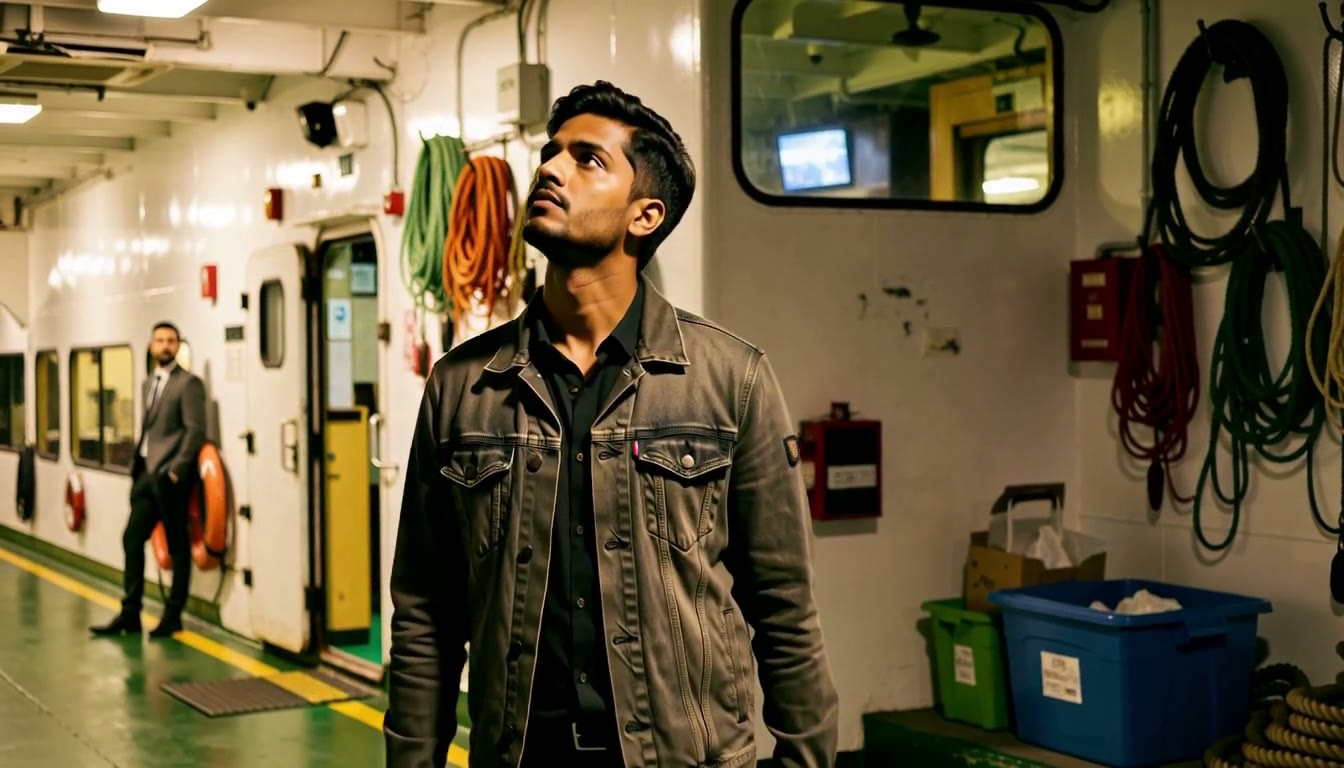
Frame 96 of 192 of the clear face clip: as it came from our film maker, the source.
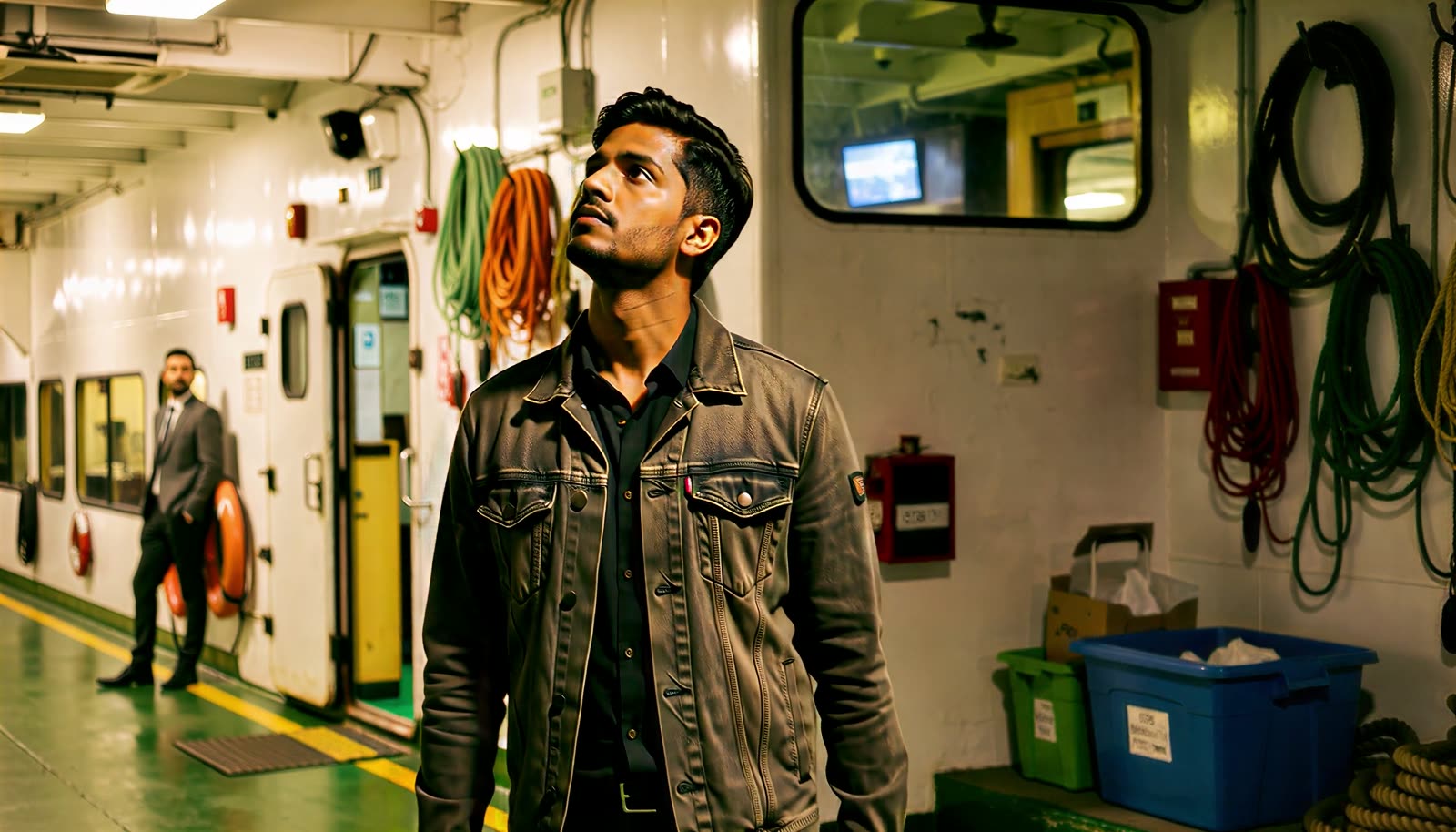
Frame 96 of 192 of the clear face clip: restored at twice the size by the 3B.
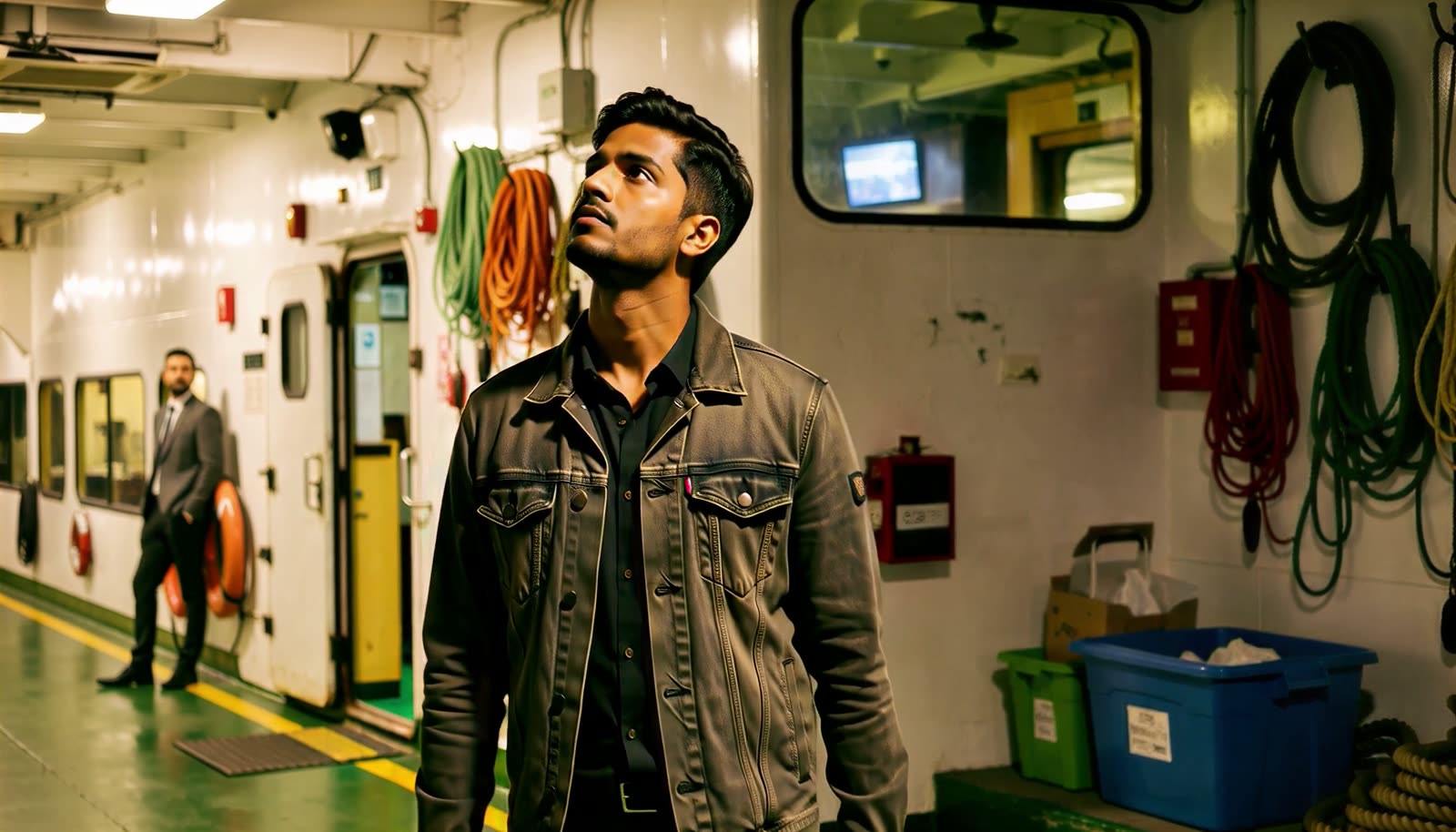
Frame 96 of 192 of the clear face clip: restored at twice the size by the 7B.

Frame 96 of 192 of the fine texture clip: as it came from our film maker, the source.

Frame 96 of 192 of the fine texture clip: restored at twice the size by the 3B.

Frame 96 of 192 of the fine texture clip: restored at twice the size by the 7B.
Watch the clips
Here are the clips themselves, with the original first. The original is the baseline, and each result is set against it.
Each player shows a web copy that plays on a phone: the original is re-encoded smaller, and the results are scaled to a width a phone can play. The link under each player is the full-size file, as the farm made it.
The results are twice the size of the original, so open the full-size files if you want to see the extra detail.
The wide shot
Baseline: The original clip
Full-size file (8.8 MB)
Change: SeedVR2 3B (int8)
Full-size file (27.7 MB)
Change: SeedVR2 7B (fp16)
Full-size file (24.0 MB)
This is the shot where the ship seems to go over the dock, and the face of the person on the dock is not clear. Both are already in the original.
The clear-face shot
Baseline: The original clip
Full-size file (5.9 MB)
Change: SeedVR2 3B (int8)
Full-size file (26.6 MB)
Change: SeedVR2 7B (fp16)
Full-size file (22.4 MB)
This is the shot where the face seems to vibrate when the person walks. It is already in the original.
The fine-texture shot
Baseline: The original clip
Full-size file (6.9 MB)
Change: SeedVR2 3B (int8)
Full-size file (25.7 MB)
Change: SeedVR2 7B (fp16)
Full-size file (23.5 MB)
This is the shot with fine texture. Look at the texture in the original and in each result. Nobody has judged which looks better.
What did we watch for?
Someone on our team watched these clips on our film’s storyboard and wrote down what looked wrong. In the wide shot, the ship seems to go over the dock, and the face of the person on the dock is not clear. In the clear-face shot, the face seems to vibrate when the person walks.
All of this is in the original clips. The storyboard plays the original, not a result of the restorer, so the restorer did not cause what was seen.
What did we see when we looked closer?
We then looked at the original beside both results, with one reader’s eyes: one frame of the wide shot and 6 frames in a row of the clear-face shot. This is a spot check, not a panel.
On the dock, the face is about 20 pixels wide, soft, and in the shadow of the cap in the original. In both results the cap, the badge, the buttons and the deck lines are sharper. The face stays soft and shaded. On that frame the restorers neither clear the face nor make it worse.
On the walking face, the face already changes shape from frame to frame in the original, as the head turns and tilts. Both results keep that. They add some texture of their own. The 3B has a grainy cheek and chin. The 7B has a lighter patch on the jaw that moves from frame to frame.
So on those frames the shaking is in the original. The restorers do not remove it, and they add a little shimmer. We did not look at enough frames to say what they do to faces in general.

The person on the dock in one frame: the original on the left, the 3B in the middle and the 7B on the right.
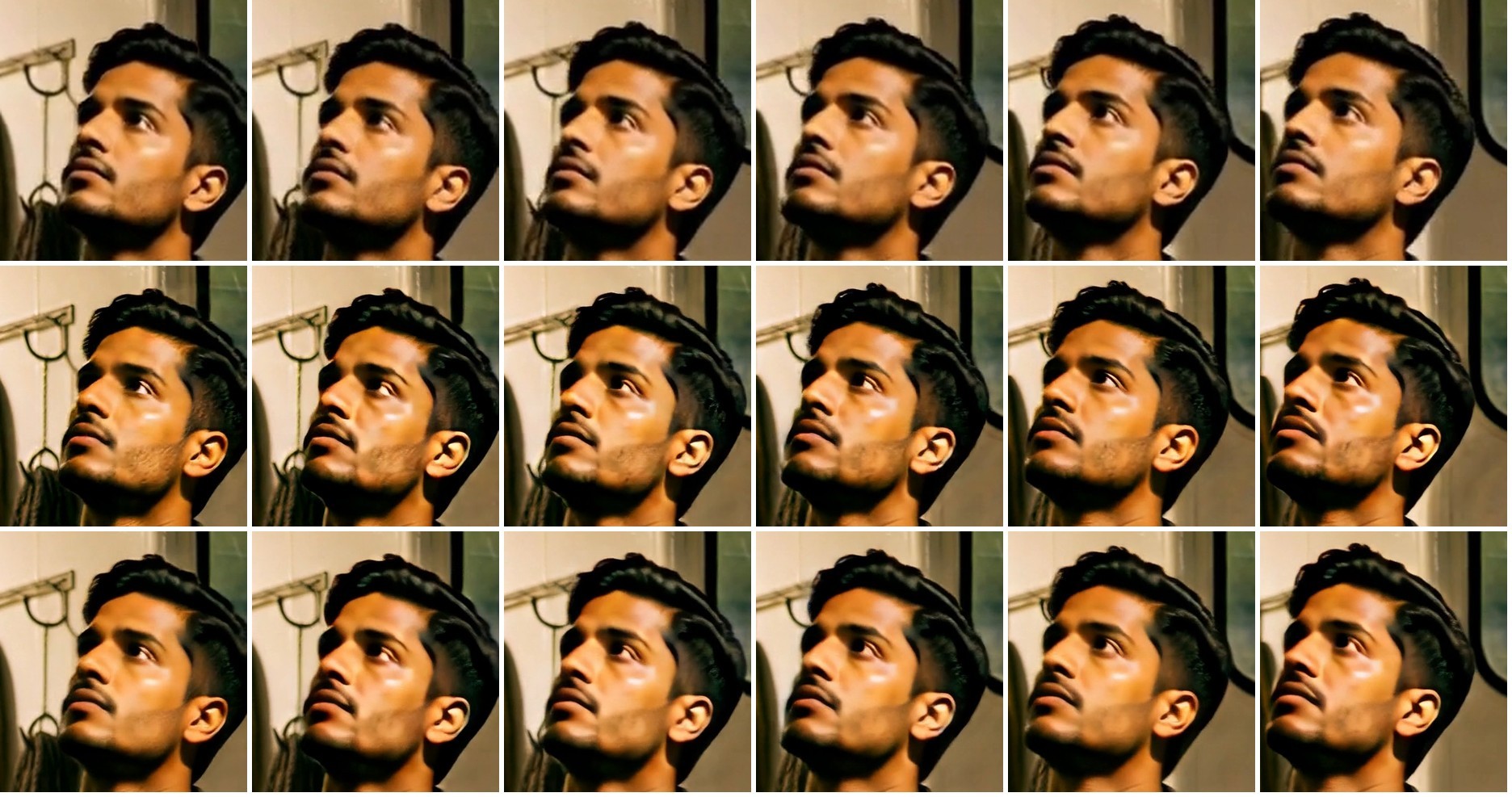
The walking face in 6 frames in a row: the original on the top row, the 3B in the middle row and the 7B in the bottom row.
Can a number show it?
The closeness scores above cannot show a shaking face. They compare the whole frame with its source, one frame at a time. A face that shakes from frame to frame, or is unclear in a small part of the picture, hardly moves them.
So we also measured, on every frame and with no model, how much the picture changes from one frame to the next. In the originals the change is steady. In both results it swells and ebbs on a cycle of 4 frames, which is 6 times a second.
The change swells and ebbs by about 10 to 15 percent. The table gives, for each shot, how strong that rhythm is in the original and in each result. It also gives how much more each result changes from frame to frame than the original does.
We do not know that this rhythm is what a person sees as shaking. We measured it on the whole frame and on a box around the face, and we did not test what a person sees against it.
We also looked for seams where the clip was cut into pieces, and none shows as a spike. That does not prove there are none, because we do not know where the seams fall.
| Shot and size | Rhythm in the original | Rhythm in the result | Change from frame to frame, result over original |
|---|---|---|---|
| The wide shot, 3B | 0.0208 | 0.2251 | 1.1484 |
| The wide shot, 7B | 0.0208 | 0.2041 | 1.0142 |
| The clear-face shot, 3B | 0.0078 | 0.2627 | 1.1595 |
| The clear-face shot, 7B | 0.0078 | 0.2241 | 1.0377 |
| The fine-texture shot, 3B | 0.0617 | 0.3196 | 1.1633 |
| The fine-texture shot, 7B | 0.0617 | 0.2836 | 1.0247 |
What can we not say yet?
We cannot say which size is faster. The small size ran first, on a card that had not loaded it, so its seconds include that cost.
We cannot say which result looks better, or whether the same person stays the same person. Those checks are still to come.
What did we not measure?
This is one card, one seed and a few clips. Some memory readings were broken in our first attempt, and we left them out of the table. Some peaks equal the memory the card already held, so they are not the job’s own, and we left those out too.
We did not try other sizes or other restorers.
What does this mean?
To double the size of a clip on one gaming GPU, cut it into pieces in time. Whole clips do not fit. Which size to use, and whether it looks better, is for a person to decide.
Quick Search Our Blogs
Type in keywords and get instant access to related blog posts.