
Measured on 2026-11-07.
Baseline and change. The baseline is Our standard card, as our model list gives it. The registry's seconds for each second of video on the standard card; the 16 GB card's runs are set against it.
The changes set against it:
- A short clip of about five seconds
- A longer piece of about nine seconds
A card with 16 GB of memory drew both a short clip and a longer piece with MiniMax H3. It was slow, and it had little memory to spare. Nobody has looked at the clips yet, so this is about fit and time, not quality.
What did we want to know?
MiniMax H3 is the video AI we use for our fastest clips. We asked a plain question. Can a card with 16 GB of memory draw a clip with it, and how long does it take?
To fit the card we used a squeezed version of the model, a file of 11.56 GB, and we put the picture together in tiles.
How did we test it?
We used one still of our own, drawn at 1,344 by 768 pixels.
We asked for a short clip of about five seconds, and then for a longer piece of about nine seconds.
We drew each length two times, with a different seed each time. The first run of each length started from an empty card. The second started with the first run’s models still loaded.
What did we find?
Both lengths fit. The short clip took 388.4 seconds the first time and 364.2 seconds the second time.
The longer piece took 947.4 seconds the first time and 908.0 seconds the second time.
The most memory the card held was 13,286 megabytes for the short clip and 14,323 for the longer piece.
That leaves room for about 3 gigabytes on the short clip and 1.7 on the longer piece.
| Length and run | Seconds to draw (s) | Per video second (s) | Peak memory (MB) |
|---|---|---|---|
| Short clip, first run | 388.4 | 75.17 | 13,286 |
| Short clip, second run | 364.2 | 70.49 | 12,202 |
| Long piece, first run | 947.4 | 100.61 | 14,323 |
| Long piece, second run | 908.0 | 96.42 | 8,869 |
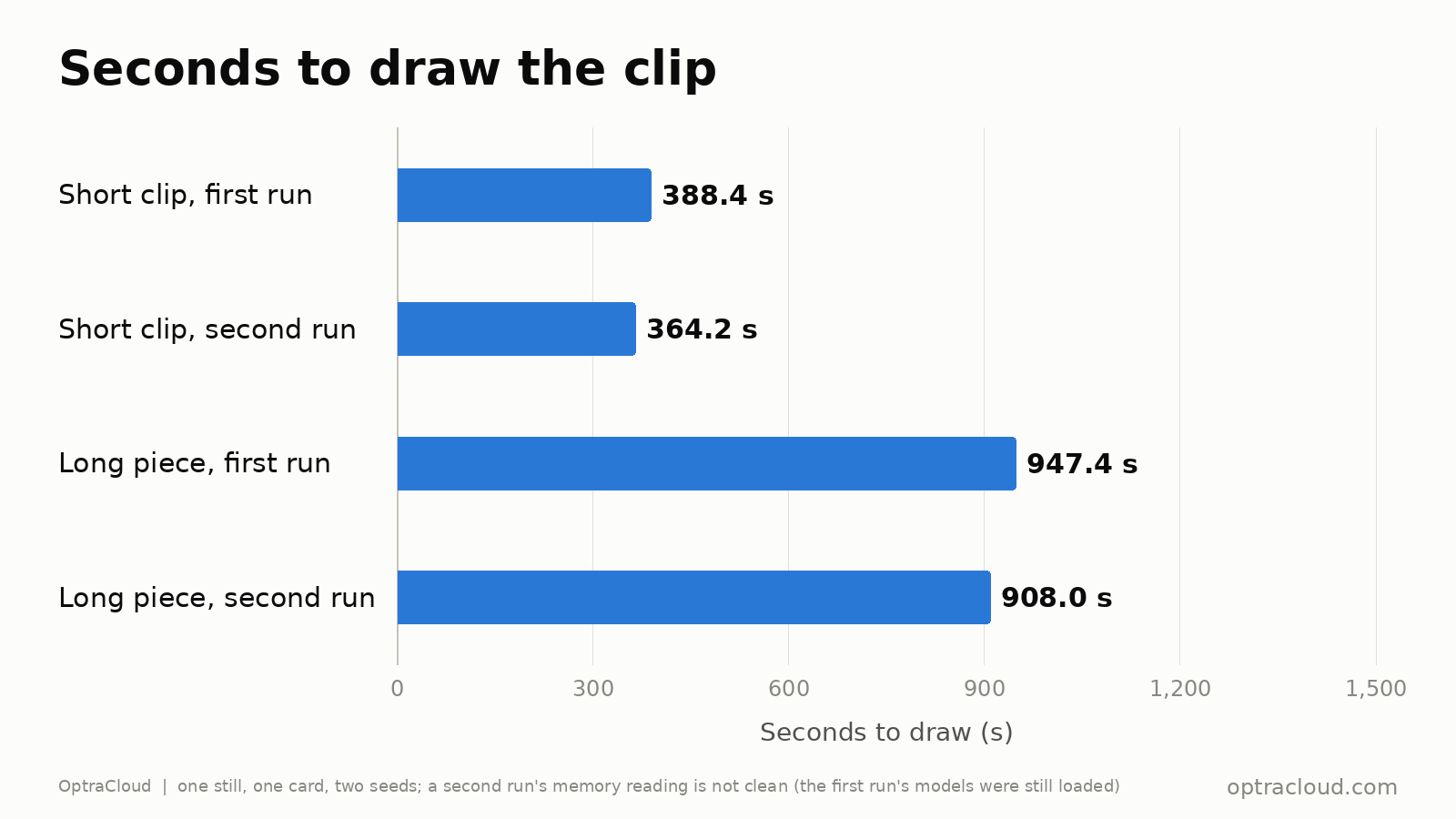
Seconds to draw the clip
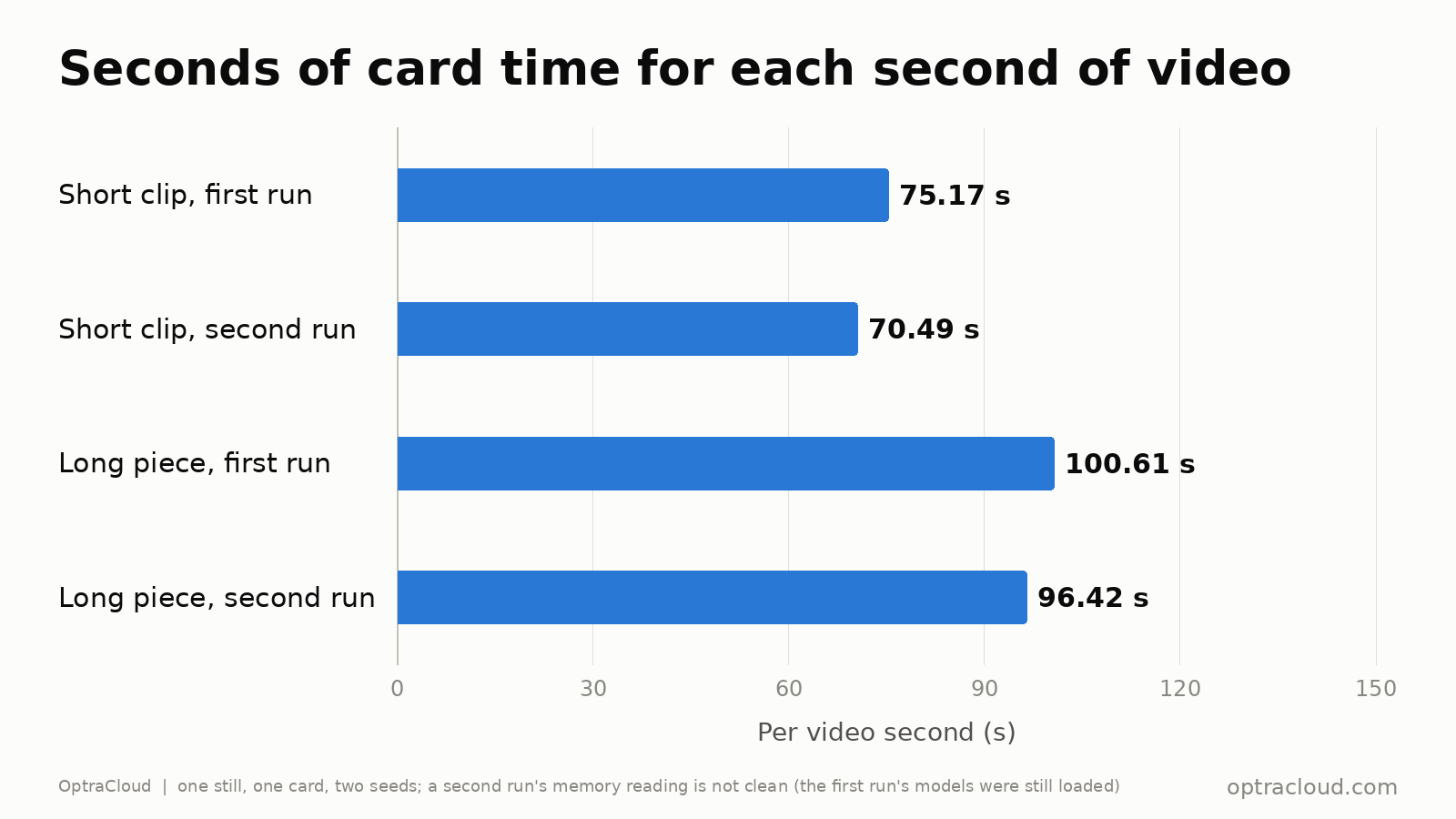
Seconds of card time for each second of video
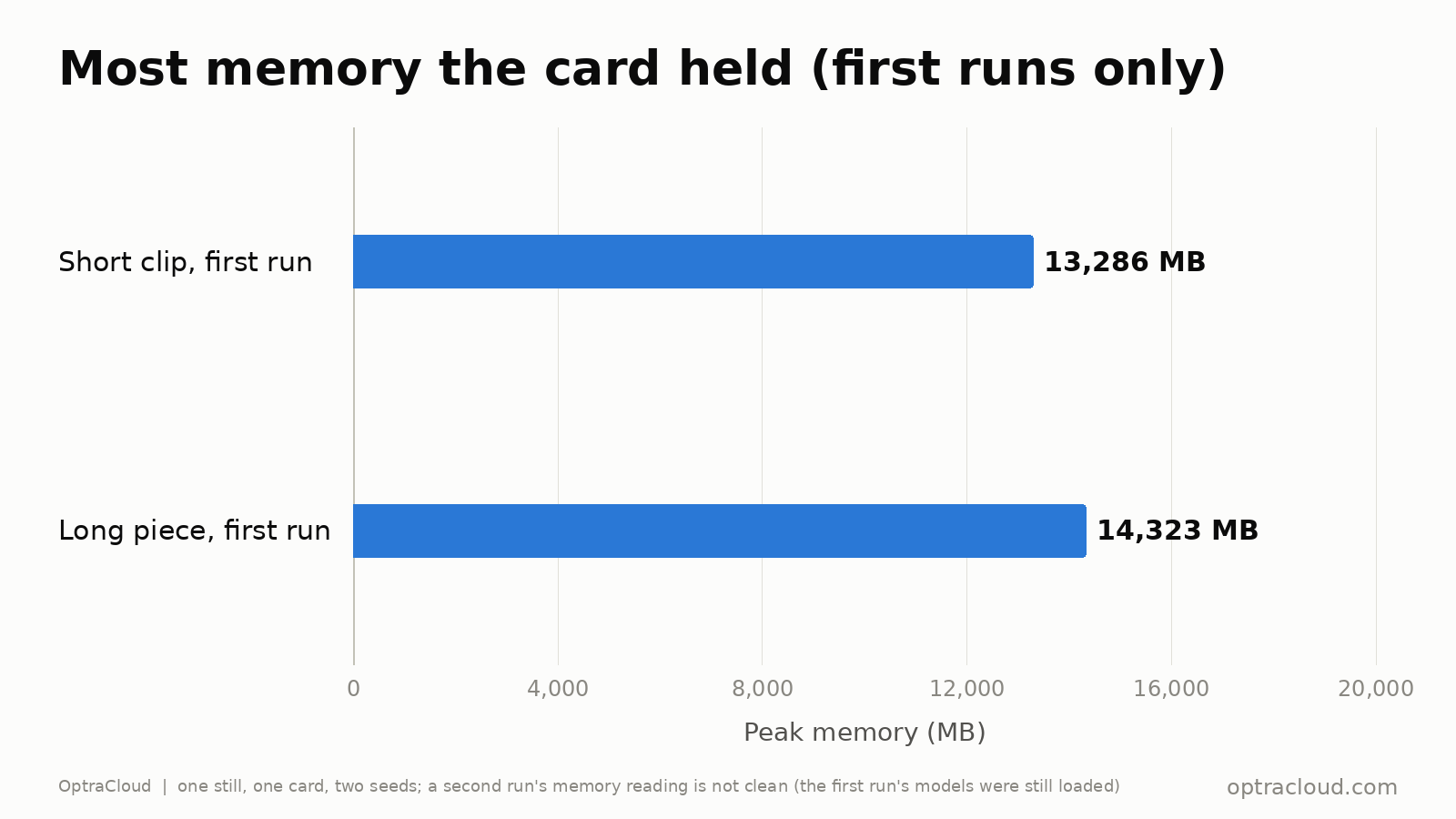
Most memory the card held (first runs only)
To share. Pictures of these numbers, made from the same record and sized for a phone:
- The table
- Seconds to draw the clip
- Seconds of card time for each second of video
- Most memory the card held (first runs only)
Does a longer piece cost more for each second of video?
Yes. For each second of video, the short clip cost 70.49 seconds of card time on the second run, and the longer piece cost 96.42.
So the speed we measure on a short clip understates a longer piece.
How does it compare with our usual card?
Our list gives this model 19 seconds for each second of video on our standard card.
This card’s second run took 3.7 times that for the short clip, and 5.07 times that for the longer piece.
Watch the clips
Here are the clips this test made, one for each run: the short clip first, then the longer piece. We did not look at them, so we say nothing about how they look.
The last player is for context only. It is the project’s own clip of the same shot, drawn on a larger card with other words and another seed. It is not a baseline, because nothing about it is like for like.
The short clip of about five seconds, first run.
The short clip, second run, on the next seed.
The longer piece of about nine seconds, first run.
The longer piece, second run, on the next seed.
For context only: the project’s own clip of this shot, drawn on a larger card with other words and another seed.
What did we not measure?
We used one still, one card and two seeds. We did not look at the clips, so we say nothing about how they look.
Our memory reading is a floor. It is taken every two seconds, so a short spike between readings is missed. The second run’s reading is not a clean one, because the first run’s models were still loaded.
A longer clip or a wider picture could still run out of memory. We tested only one length and one size of each.
What does this mean?
A card with 16 GB of memory can draw a MiniMax H3 piece up to the longest length we tried. It is slow, and it has little memory to spare.
Whether the result is good enough to use is the next question.
Quick Search Our Blogs
Type in keywords and get instant access to related blog posts.


