
Measured on 2026-09-01.
Baseline. This test has no baseline: it is not a side-by-side run.
In Optra Studio. This test has no page in Optra Studio: it benches a method on a GPU box, and has no project page.
No outputs to show. We measured how fast the drives read and computed the rest from published file sizes. We did not run the tool, so there is no model output to show. The measured numbers are the drive speeds in the first table.
The tool really can run a huge AI model on a small GPU, but one word needs minutes. It is a tool for overnight batch jobs and not for chat.
What did the post claim?
A viral post said a tool called AirLLM runs a huge model, Llama 3.1 405B, on a single 8 GB GPU. It does this by loading one layer of the model at a time from disk.
We asked a plain question. Could our own workstation run it, how fast, and is it any use?
What did we measure?
Our workstation has a pair of RTX 5090 GPUs, with 31.8 GB usable on each. The tool uses only one of them. We measured how fast its drives read, using reads that skip the operating system’s cache.
| Drive | Read speed (GB/s) |
|---|---|
| Fast NVMe drive | 5.55 |
| Large hard disk | 0.28 |
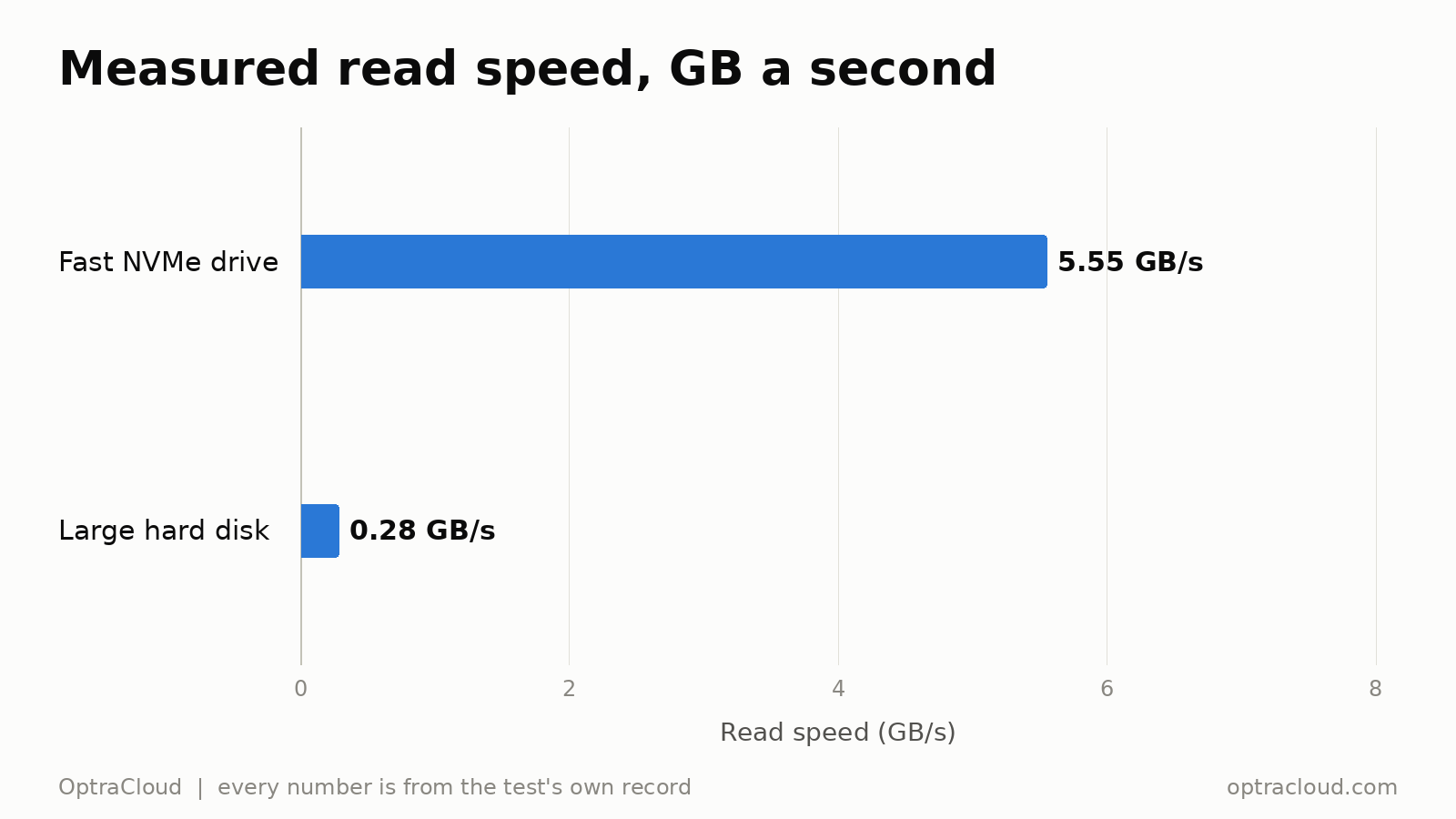
Measured read speed, GB a second
To share. Pictures of these numbers, made from the same record and sized for a phone:
Does a huge model fit?
Yes, every one we looked at. The largest layer of the biggest model is smaller than the GPU. That is the trap. The GPU is never the limit. The disk is, because the tool reads the whole model off disk for every word.
The hard disk is 19.8 times slower than the fast drive. A model split onto the wrong drive would be unusable.
How long does one word take?
We computed it from each model’s file size and our measured disk speed. We say “word” below. Strictly, tokens are small pieces of words. The table shows the time per word on each drive, and how long a paragraph of 200 tokens would take on the fast one.
| Model | File size, GB | A word, fast drive | A word, hard disk | A paragraph, fast drive |
|---|---|---|---|---|
| Llama 3.1 405B | 812 | 2 min | 48 min | 8.1 hours |
| Qwen3-235B | 470 | 85 s | 28 min | 4.7 hours |
| Qwen3-32B | 66 | 12 s | 4 min | 0.7 hours |
Can we trust our arithmetic?
We checked it against the only published benchmark we found, by a third party, on a different machine. They measured 13.3 seconds a word on a 32-billion-parameter model. Our arithmetic predicted 11.8 for the same model on ours.
That is within 13 percent. We treat our table as an optimistic floor, because extra memory does not remove the cost of loading each layer.
What about the tool’s compression option?
Its own page promises a 3 times speed-up from compression. The same third-party report measured it between 3.8 and 8 times slower, with higher memory use. We would leave it off.
Should anyone use it for a smaller model?
No. A pair of RTX 5090 GPUs hold a 70-billion-parameter model squeezed to INT4 with room to spare, and a good serving tool runs it at full speed. Our own production model answers at 58.9 words a second.
The same tool on a 32-billion-parameter model on this machine gives 0.1 words a second. That is about 695 times slower, on better hardware.
Is it useful for anything?
Yes, for batches. The tool loads each layer once and applies it to a whole batch of questions. So the cost depends on how many times it sweeps through the model, not on how many questions it answers.
An early draft of our own note said a benchmark run would take months. That was wrong. The table shows a run of 14,042 exam questions on the biggest model.
| How the questions are run | Hours |
|---|---|
| One at a time | 574 |
| In batches of 32 | 21 |
| In batches of 64 | 18 |
What is that good for?
Overnight jobs on models we cannot otherwise touch. One is checking a squeezed copy of a model against the full-precision answers. Another is a full-precision test of a large model before we decide to serve it.
It is not for chat, for serving or for anything word by word.
What did we not measure?
We measured the drives and computed the rest. We did not download or run a giant model. None was on the machine, and each download is hundreds of gigabytes.
Our check of the arithmetic rests on one outside benchmark.
What does this mean?
A claim that a big model fits on a small GPU can be true and still useless for your job. Ask what the limit really is. Here it was the disk, and the answer was minutes per word.
Quick Search Our Blogs
Type in keywords and get instant access to related blog posts.


